- RECORDED2026-10-17
- PARCELMillrose Properties, Inc. (NYSE: MRP)
- PRICE AT ISSUE$22.50, October 16th close
- HOLDINGS143,771 homesites / 877 communities / 30 states
- BOOK VALUE$35.24 a share, priced at 0.64x
- FEE INCOME$204m a quarter, run-rate at June 30th
- ENCUMBRANCES$2.5bn debt at June 30th, $1.0bn notes added since
- PENDINGClass action, lead-plaintiff deadline Dec 8th
- NEXT DATESBeazer closing Oct 20th, Q3 results Oct 27th
- CLASSIFICATIONHigh risk / 12-18 month horizon
On October 8th Hunterbrook published its second report on Millrose, with a bigger number in it than the first: 1,096 houses bought from Lennar in about a month, roughly $290m, nearly all of them now advertised as ordinary rentals. I expected that to break the stock again. It printed $21.66 intraday, its lowest price since April 2025, then closed at $22.63, above where it had closed three sessions earlier. Four sessions later it did break, with no news from the company: $21.07 on October 14th, five cents above its March 2025 low. By Friday it was back at $22.50.
My view is that market is right to be angry and wrong about the size of the bill. Millrose owns land for homebuilders and charges them a monthly fee while it holds it. By June those fees were running at $204m a quarter. No builder has walked away from a single option since listing, and contracted income covers the dividend. At Friday's close of $22.50 the dividend yields 14.0% and the shares trade at 0.64 times book value. That price is almost exactly what our model says the bear case is worth. Part of that bear case was a failed Beazer deal. Beazer's shareholders approved it on October 15th.
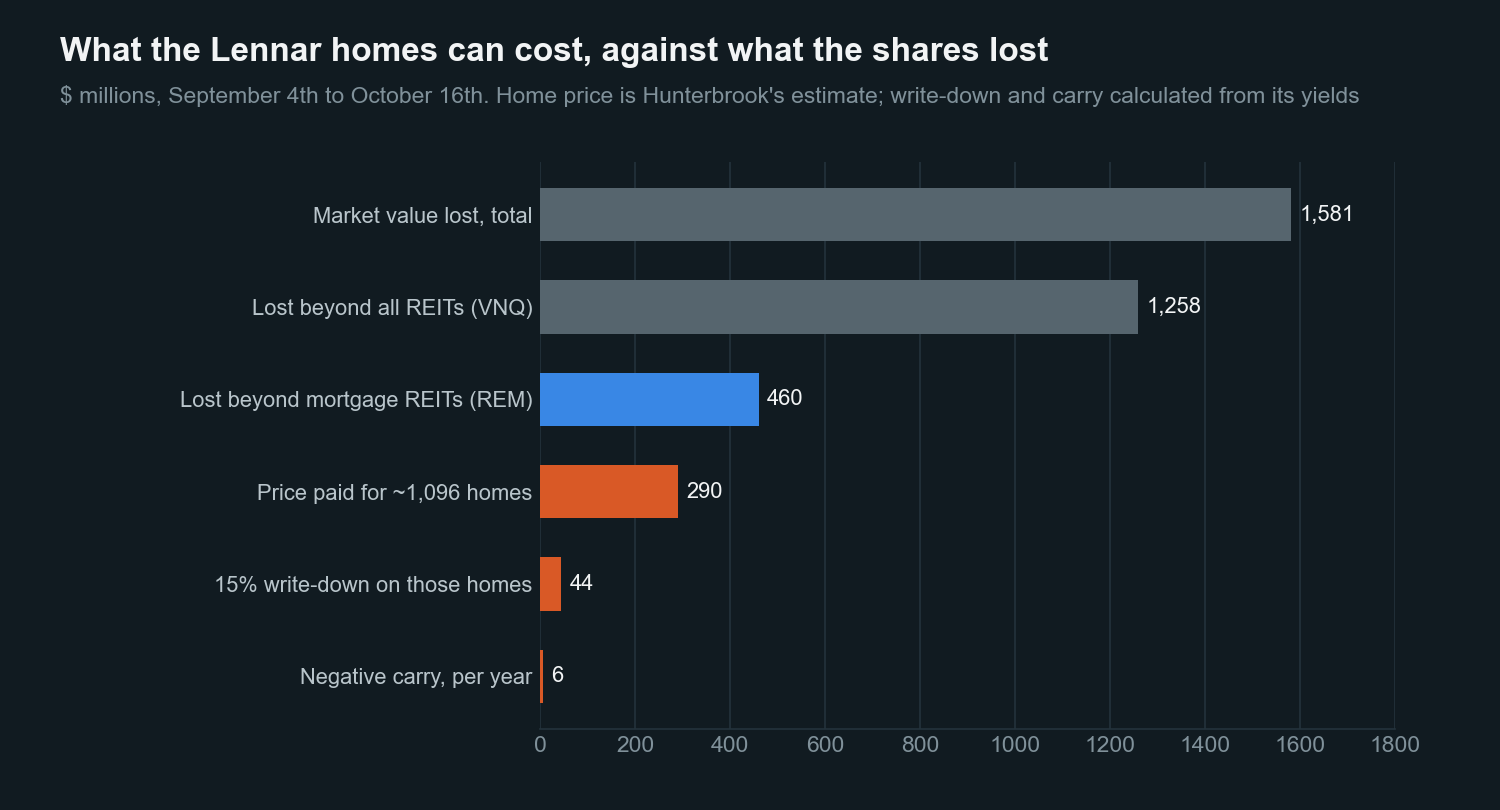
Most of the fall happened before anyone published anything. From $32.02 on September 4th the stock had already dropped to $25.20 by October 1st, a day before Hunterbrook's first report, while 10-year Treasury yields jumped almost half a point and mortgage REITs fell 15%. Very little of Millrose's income moves with rates. Measured against those mortgage REITs, part of the decline that belongs to Millrose alone comes to about $460m of market value. On Hunterbrook's own figures, the houses cost Millrose about $6m a year.
None of that makes this comfortable. Millrose has said nothing in public since Hunterbrook's report, because it is in its quiet period before results. Its annual report told investors it would have no tenants. It is now a landlord. Lennar, which supplies two-thirds of its capital, saw third-quarter earnings halve and, on Hunterbrook's count, needed those sales to clear the bottom of its delivery guidance. A securities class action has been filed. Price is still below every moving average on the daily and weekly charts.
I can't tell you what the results will show. I can put a price on each of those problems and set it against the cash this business produces. Third-quarter results on October 27th, a week after the Beazer deal is due to close, will start answering what the share price is charging for. This scenario collects a covered dividend while they do. Risk/reward at the midpoints is asymmetric.
Ian Andy, Research Desk, Bellwether Research, October 17th, 2026
Land Held for Someone Else's Balance Sheet
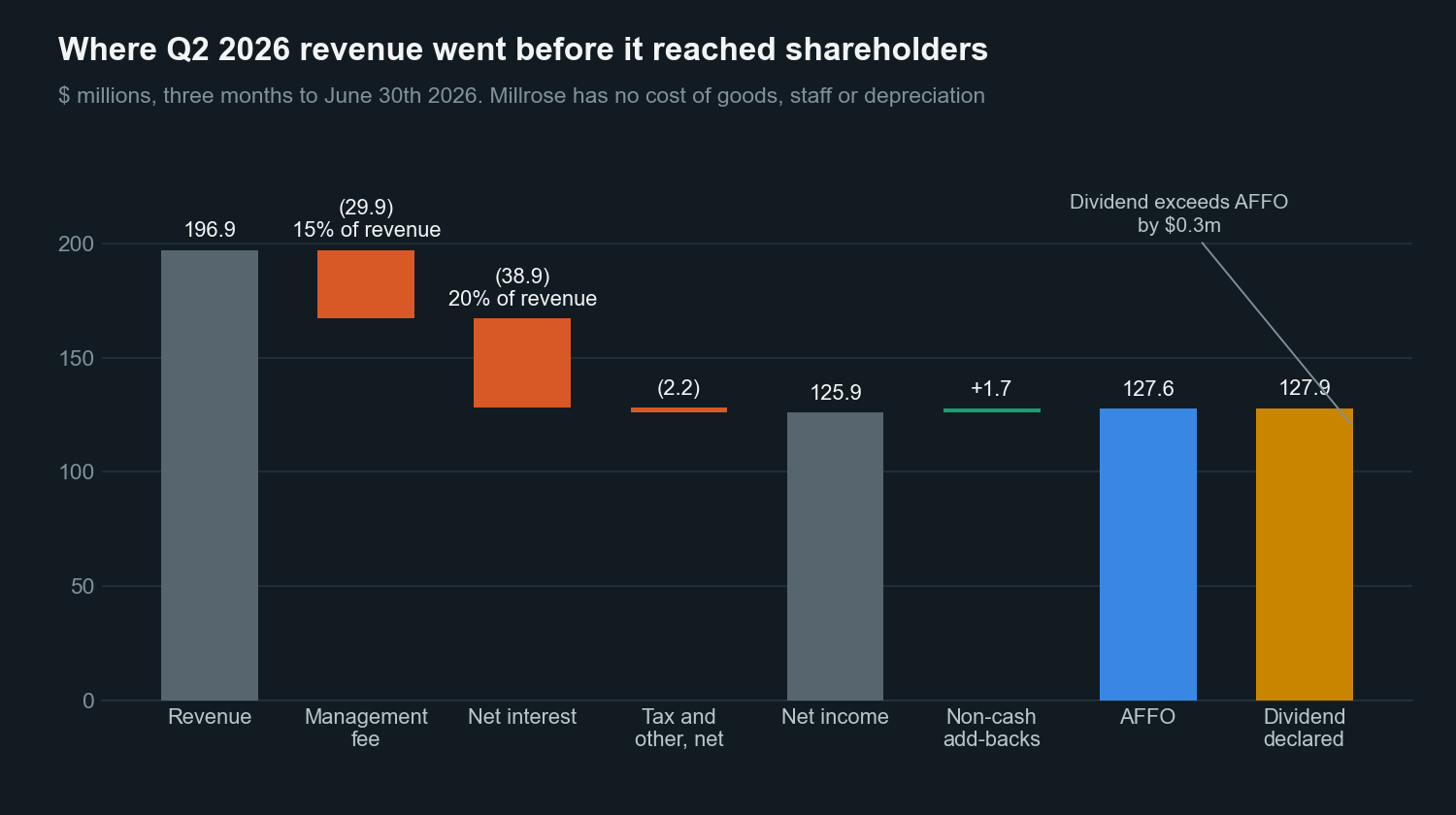
Millrose is a land bank. A homebuilder picks a parcel it wants to build on in a few years. Millrose buys it, pays for the grading, roads and sewers that turn raw land into finished lots, and sells the lots back to that builder on a fixed schedule at cost. Until each lot is taken down, the builder pays a monthly fee on the money Millrose has tied up. Option fees were $195.4m of $196.9m of revenue in second quarter.
Why would a builder pay 8.5% to 10.6% a year to hold land it could finance with its own bonds at 4% to 6%? Because shareholders reward builders that own less of it. A builder that options its lots ties up less capital and turns it faster. In a downturn, its loss stops at the deposit.
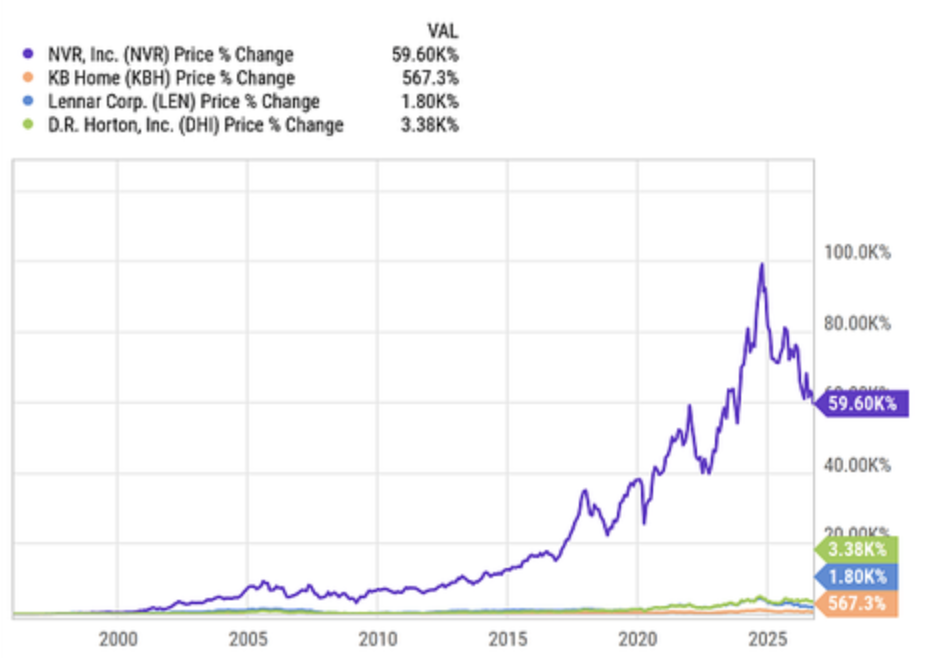
That model is spreading. D.R. Horton controlled 78% of its land and lots through purchase contracts at the end of June. Toll Brothers owned only 42% of its lots at the end of July. Lennar says less than 5% of its land is now on its own balance sheet. On Millrose's August call, chief executive Darren Richman pointed to a full year of falling owned-and-controlled lot positions at listed builders, who are "now more regularly outsourcing ownership to third-party capital providers like ourselves."
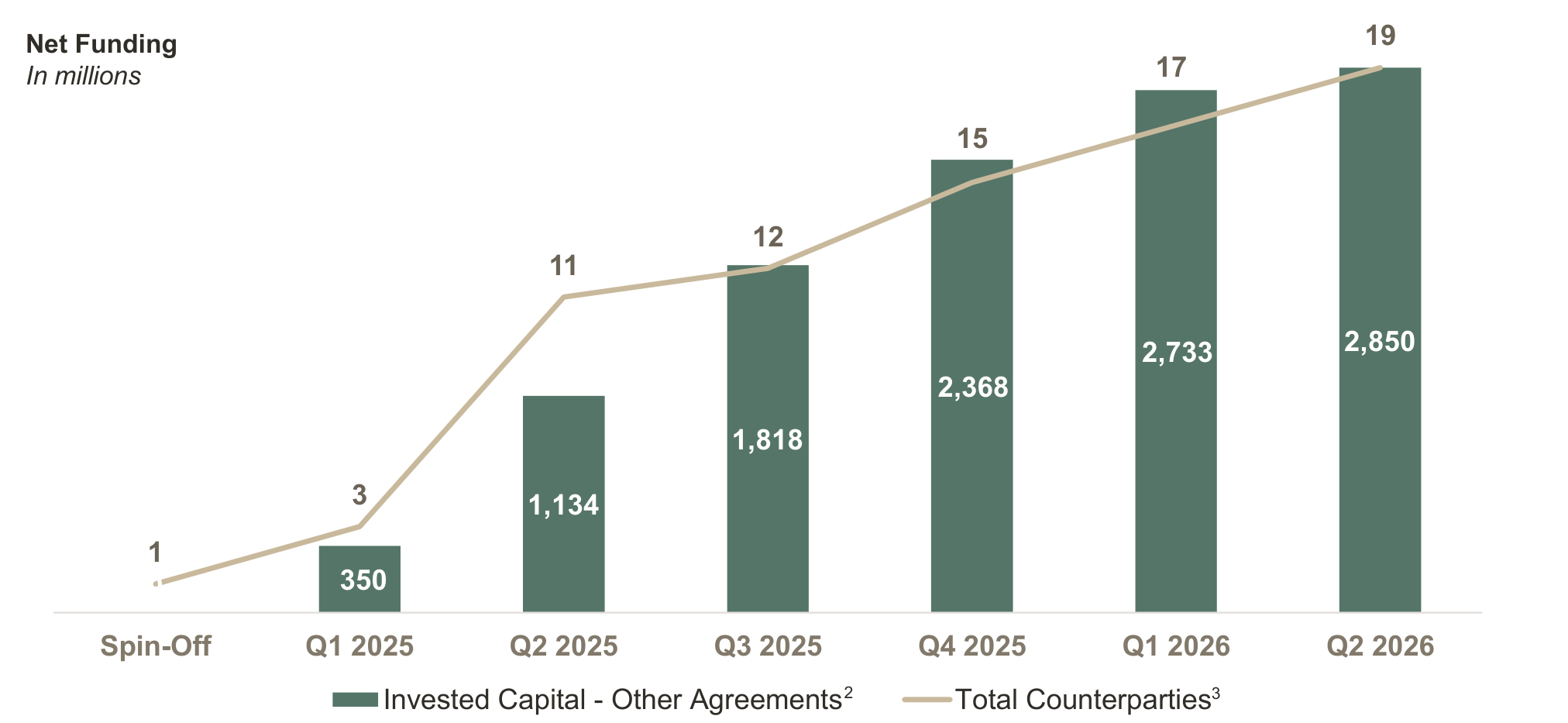
Millrose started life with a single customer. Lennar contributed about $5.5bn of land and $1.0bn of cash at the spin-off. It still accounts for 68% of invested capital and pays a fixed 8.5%. Growth since then has come from the other 32%: 18 builders and developers paying an average 10.6%, among them Taylor Morrison, New Home and Dream Finders, in a book of business that was zero on listing day. Multiply each book by its rate and you have the revenue line. At the end of June, $5.95bn at 8.5% and $2.85bn at 10.6% put option fees at $204m a quarter, more than a third of it now paid by builders other than Lennar.
What reaches shareholders is a narrower number. No profit is made on the lot itself. Each takedown just returns capital, which goes straight into the next parcel. Shareholders keep the fee, less three costs: interest, a sliver of tax and a 1.25% management fee to Kennedy Lewis, external manager that supplies every officer Millrose has.
Paying out everything means Millrose can't grow from retained earnings. New land has to be bought with borrowed money or new shares. Management has promised not to sell shares below book value. With the stock well below book, growth means debt, capped by the company at 33% of capital. So balance sheet sets the pace, which makes debt as important to watch as fees.
Each contract works like an out-of-the-money put that Millrose has sold on a community. It collects a premium every month, gets nothing if home prices rise, and loses only if a builder decides its lots are worth less than what it still owes plus the deposit it would forfeit. Getting there takes a fall in land values deep enough to erase the builder's margin. There is a catch, though. Sold puts lose money fastest when prices gap down. No builder has walked away once since the spin-off, a record Richman is careful not to oversell.
"Because it hasn't happened, doesn't mean it won't happen."
Darren Richman, CEO and President, Millrose Properties, Q2 2026 earnings call
Two Selloffs in Five Weeks
From its September 4th close of $32.02, Millrose had already fallen to $25.20 by October 1st. Hunterbrook's report came the following day.
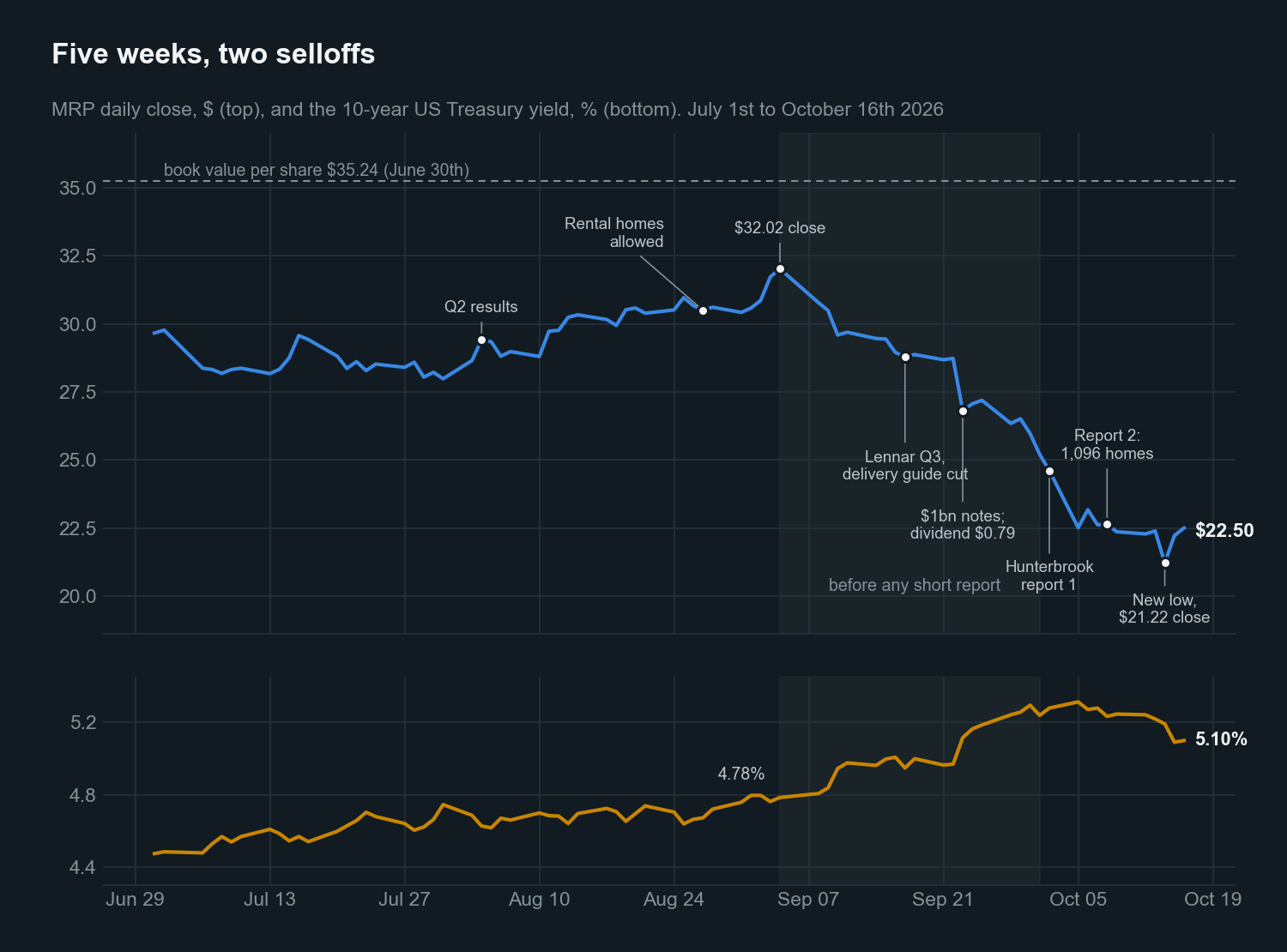
September's selling had more than one cause. Rates were obvious one - the 10-year rose about 45 basis points in four weeks, while mortgage REITs, the closest listed category to Millrose, lost 15% including dividends. Then came leverage, which is where the payout policy bites. Millrose's revolver, moved onto unsecured terms in March, stood at $850m on September 21st against $485m in June. Two days later it priced $500m of 6.50% notes due 2029 and $500m of 6.75% notes due 2031, which in our model take debt to about 34% of capital, past the company's own ceiling. For a business that cannot grow without borrowing, that was the line that mattered. And then strategy. Amendments signed on August 27th let Millrose buy finished single-family homes and run them as rentals, after its annual report had told investors it would have no tenants. At first the market did not seem to mind...shares rose 5% over six sessions after the amendments were signed. I read that as a market that priced the rental pivot only once it saw what the pivot had bought.
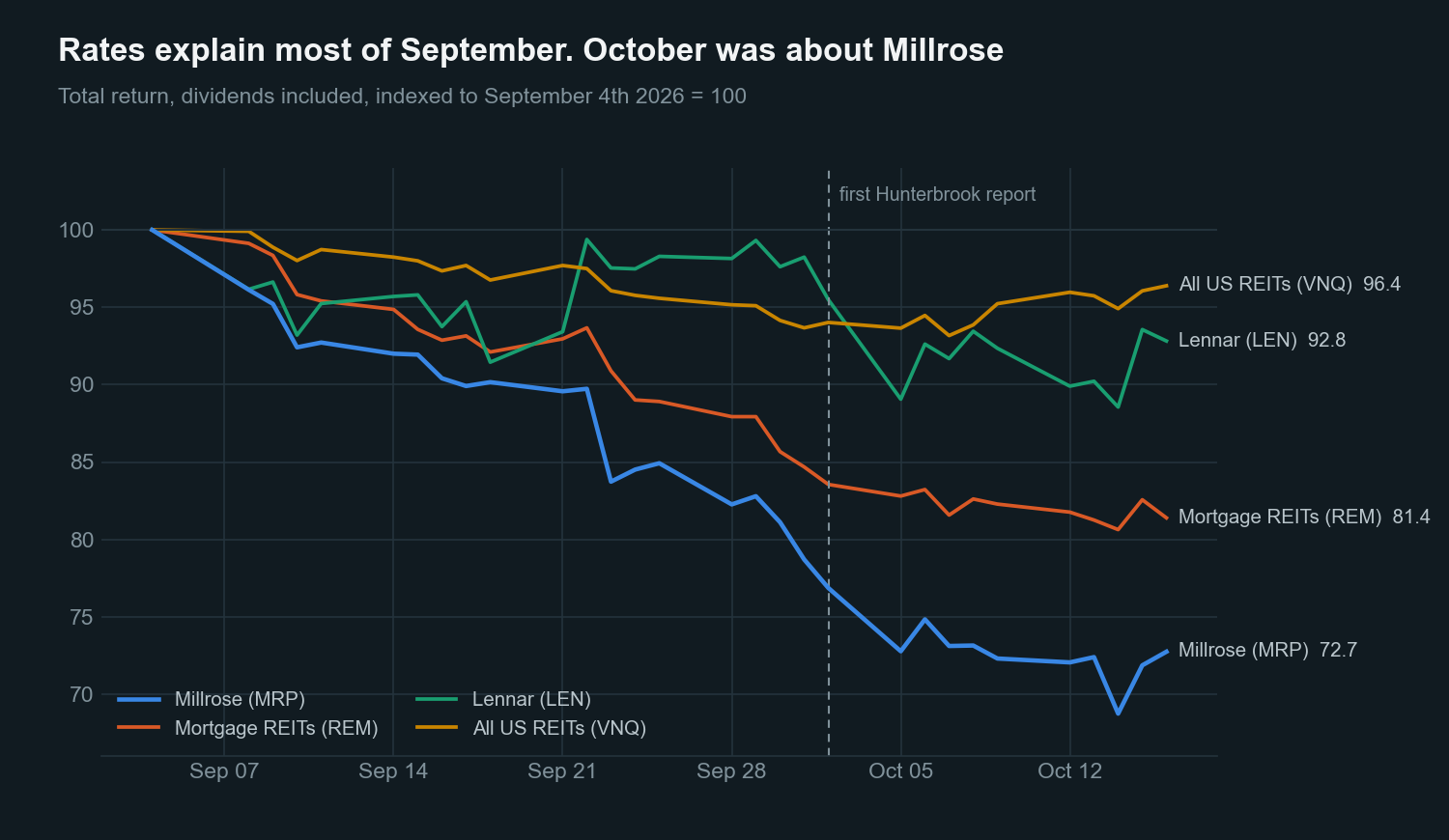
That rate shock explains the September selling better than it justifies it. A mortgage REIT loses book value when yields rise because its bonds are marked to market. Millrose carries its land at cost, Lennar's 8.5% is fixed, other builders' rates float above contractual floors, and about four-fifths of its debt is fixed-rate notes. On our model a 45-basis-point rise in the required return takes about $1.15 a share off the dividends' value, under 4%. September took 21%.
Lennar's line is the interesting one. Through September, with its third-quarter orders down 9% and full-year delivery guidance cut, Lennar's shares fell less than 2%. Millrose fell 21%. Whatever drove September, it was not fear about the credit of Millrose's largest customer.
October was different. Both stocks lost about 8.5% once Hunterbrook alleged two companies had traded houses to hit a quarterly number.
Then Millrose fell on its own. On October 14th it lost 5.2% while homebuilders fell 1.5% and mortgage REITs less than 1%. Millrose filed nothing that day. That day's only fresh research on the stock was an Argus quantitative report cutting its target to $21. Next day the shares recovered 4.7% as the 10-year yield fell 10 basis points and homebuilders rose 4%.
There were reasons for all that selling. Several are still live. One uncertainty is nearly gone - on October 15th, in a result announced after the close, Beazer's shareholders approved the Dream Finders deal. It unlocks Millrose's largest acquisition financing to date and is due to complete on October 20th. Third-quarter results on October 27th are management's first scheduled chance to answer the rest in public.
Hunterbrook's Numbers, Run Through Millrose's Accounts
Hunterbrook, which discloses short positions in both Millrose and Lennar, has now updated its count. Its October 8th report counts 1,096 purchase records in 16 states worth an estimated $290m, built from deeds. Of those, 471 had no recorded price and were estimated from listings. I have no way to check the counts independently. Of the 1,040 homes it matched to street addresses, 991 were listed as available rentals on the website of Evergreen, Millrose's property manager, as of October 6th. Evergreen's call-centre staff told its reporters they offer ordinary 12- and 18-month leases and no rent-to-own.
That last finding matters more than dollar amount. According to Hunterbrook, Goldman Sachs' September 30th recap of its discussion with management described a "rent-to-own hybrid product" in which a renter is often lined up before Millrose buys. If Evergreen's version is right, the explanation management gave investors was wrong. That is a credibility cost whatever the houses earn.
On the economics I'd rather use Hunterbrook's figures than mine, since they are the least flattering available. Gross rent on listed homes comes to 8.44% of purchase price, falling to 5.92% after property tax and insurance. Kennedy Lewis takes its 1.25% on these assets as on any others, which leaves about 4.7%. New debt costs 6.625% on average. On $290m that gap comes to roughly $6m a year, or 3.5 cents a share, about 1% of run-rate AFFO.
A write-down would also be small. Typical home values in the affected ZIP codes fell 9% over the past year on Zillow's data, against a small national rise. A 15% write-down across the whole purchase would cost about $44m once, under 1% of book value.
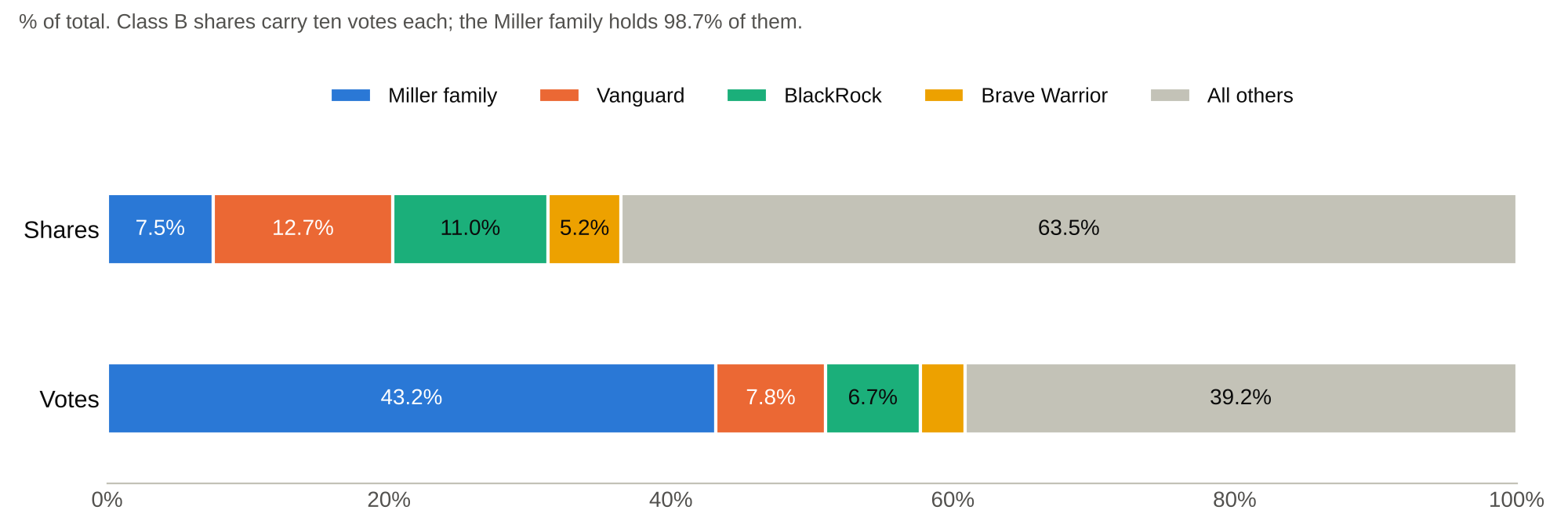
Lennar is 68% of invested capital and paid 85% of option fees in 2025. Stuart Miller, Lennar's executive chairman, controls 43.2% of Millrose's votes. Millrose has no employees of its own. Its manager is paid on assets, so a larger balance sheet raises the fee whether or not new assets earn their cost. Hunterbrook quotes accountants asking whether the pattern means Lennar controls Millrose for accounting purposes. An auditor reaching that conclusion would push Lennar to bring Millrose's land back onto its own balance sheet, which would remove the reason such structure exists.
Institutions hold 86.5% of the shares, Vanguard and BlackRock about a quarter between them, yet the vote is controlled elsewhere.
My reading is that the purchases were a mistake that will probably stay small. A mistake, because a land bank that buys its largest customer's unsold homes at a negative spread, hundreds of them in the last week of that customer's quarter, spends trust it will need when it next asks bond investors for money. Likely to stay small, because the economics punish repetition quickly. Every further $300m at Hunterbrook's yields costs another 3.5 cents of AFFO a year on a dividend paid out to the cent, so a second round would show up in the payout within a quarter.
That's my judgement, which the filing will test. If the third-quarter disclosure shows purchases continuing into Lennar's November quarter, or a total above roughly $350m, this scenario's thesis is broken.
Important Disclaimer
This content is for informational and educational purposes only and does not constitute financial advice, investment recommendations, or solicitation to buy or sell any securities. Past performance does not guarantee future results. All investments carry risk, including the possible loss of principal. Shares of Millrose Properties, Inc. (NYSE: MRP) are subject to significant risks including: dependence on Lennar Corporation for approximately 68% of invested capital and the majority of option fee revenue, together with contractual rights held by Lennar to pause takedowns at reduced fees, claim lower option rates, reserve capital and approve replacement managers; purchases of finished single-family homes from Lennar for rental use, reported by a short seller to have been made at returns below Millrose's cost of debt and not yet disclosed by the company, and related questions of control, related-party dealing and accounting consolidation; a securities class action filed on behalf of purchasers between February 7th 2025 and October 2nd 2026; external management by Kennedy Lewis under a fee calculated on tangible assets rather than on shareholder returns, and allocation of opportunities between Millrose and other Kennedy Lewis vehicles; a dual-class share structure under which the Miller family controls approximately 43% of voting power; leverage that is expected to exceed the company's stated 33% debt-to-capitalisation target, a sub-investment-grade credit rating reported by one broker, refinancing at higher coupons, and a 100% AFFO payout policy that leaves no retained cushion; land-value risk on homesites protected by builder deposits of approximately 10% and pooling provisions that have not been tested by a termination; geographic concentration in California, Texas and Florida, including exposure to hurricanes, flooding and insurance costs; sensitivity to mortgage rates, homebuilder margins, housing demand and employment; the Dream Finders Homes acquisition of Beazer Homes, approved by Beazer stockholders on October 15th 2026 and expected to close on October 20th, whose failure to close by May 13th 2027 would require redemption of $500 million of notes; REIT qualification and tax rules; and reliance on non-GAAP measures including Invested Capital and AFFO. Figures attributed to Hunterbrook are that firm's own estimates and it discloses short positions in Millrose and Lennar. Technical analysis presented reflects historical price and volume data and is not a guarantee of future movements; support and resistance levels, relative-strength readings, moving averages, Elliott wave counts, order blocks and Fibonacci retracements are lagging or interpretive indicators with well-documented limitations. Scenario analysis, price targets and probability weightings are based on publicly available information, independent modelling and analyst-consensus data as of October 16th 2026; actual results may differ materially. Entry, target and stop levels reflect scenario-based analysis, not price predictions. Always conduct your own due diligence and consult a qualified financial advisor before making any investment decision. Position-sizing observations are general in nature and do not account for individual circumstances, tax situations or risk tolerance.