Argan closed Wednesday at $402.13. It last traded down there on March 26th, the afternoon before it reported the best quarter it had ever printed. Since that afternoon it has reported two more.
Arithmetic first. On March 26th trailing twelve-month earnings stood at $8.49 a share against a close of $410.85, which is 48.4 times. Wednesday's close comes against trailing earnings of $12.66, which is 31.8 times. Price is 2.1% lower. Profit underneath it is 49% higher.
Whatever repriced this stock over the last ten weeks, earnings were not the cause.
Wednesday supplied a tidy illustration of what did. A broker opened coverage before the bell with an Underweight rating and a $273 target. Shares fell 7.93% on 570,000 shares, about 1.5 times their daily average, closing within $3 of the session low. Seven hours after that, the board raised the quarterly dividend by 40%, a fourth consecutive annual increase. Two events, one calendar date. Only one changed anything inside the business.
Argan's de-rating has run well past the facts that started it. What this market has priced out is a fresh wave of gas-fired awards. That is the one thing management has flatly refused to move on its calendar. Three consecutive quarterly calls from three different vantage points have pointed at the same window: roughly April to December 2027. Guidance that is failing gets pushed out. Argan's has not moved an inch.
None of which makes the bear case foolish. I'll put that on the record early. Backlog has fallen three quarters running. Consolidated gross margin has stepped down across three quarters, 25% to 21% to 19.3%. Insiders have sold some $136m of stock in twelve months and bought precisely none of it back. Argan's own accounts contain a two-year stretch when revenue fell 73% and gross margin went negative. So I built this scenario's invalidation around that history, not around my own confidence in it.
Ian Andy, Research Desk, Bellwether Research, September 10, 2026
Round Trip to March
Four dated closes, each sitting on a different amount of reported profit. Order matters, because that multiple moved both ways across six months and the two moves had nothing to do with each other.
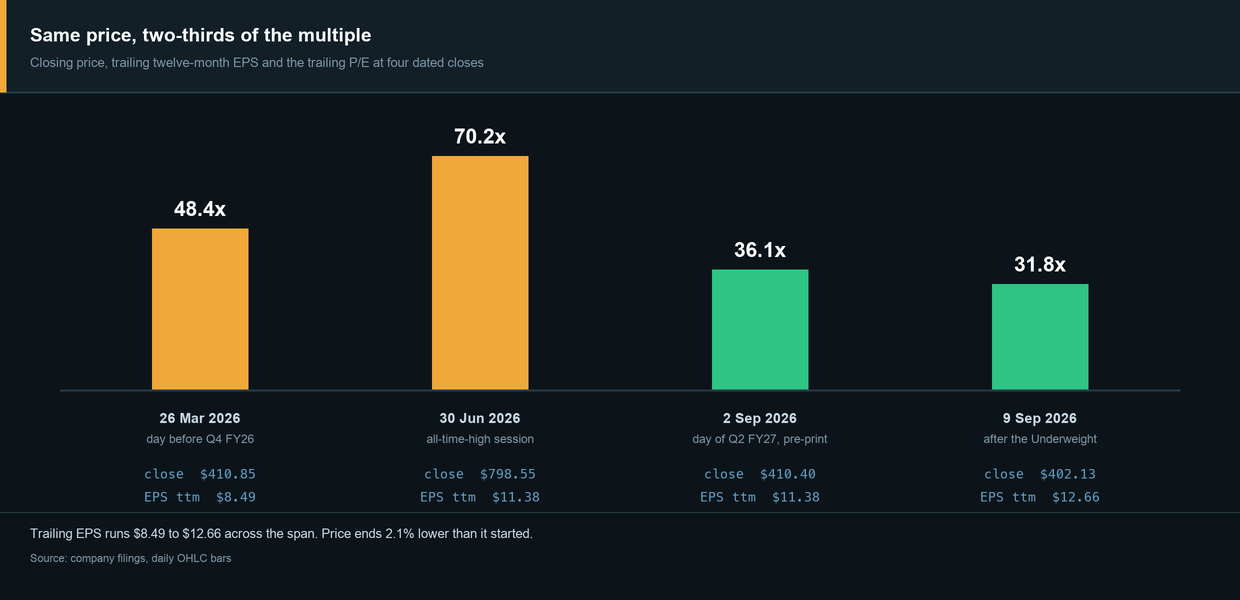
Between the first bar and the last, three sets of results landed. Q4 FY2026 beat consensus by $1.49 a share. Q1 FY2027 beat by $0.91. Q2 FY2027, reported on September 2nd, beat by $1.10 on revenue of $383.98m, which came in $83.36m above the estimate and 61.5% above the prior year. Three straight quarters in which the sell side was wrong by 75%, 39% and 41% in turn, yet AGX finished the sequence below where it began. That gap between delivery and price is the entire opportunity, and the reason the risk is real. A market that ignores three beats can ignore a fourth.
On June 5th, the morning after Q1 landed, AGX gapped to an intraday high of $779.00 and closed at $694.72, giving back all of a 13% pre-market pop in one session. On September 3rd, the morning after Q2 landed, it gapped to $433.98 and traded down to $400.60 before closing at $411.77. Same pattern, three months apart, on the two best results in Argan's history. Whoever has been selling Argan into strength has been doing it methodically, not emotionally. That is not panic. That is a redemption queue, or an index weight coming down, or a fund whose mandate no longer covers a stock at 70 times earnings.
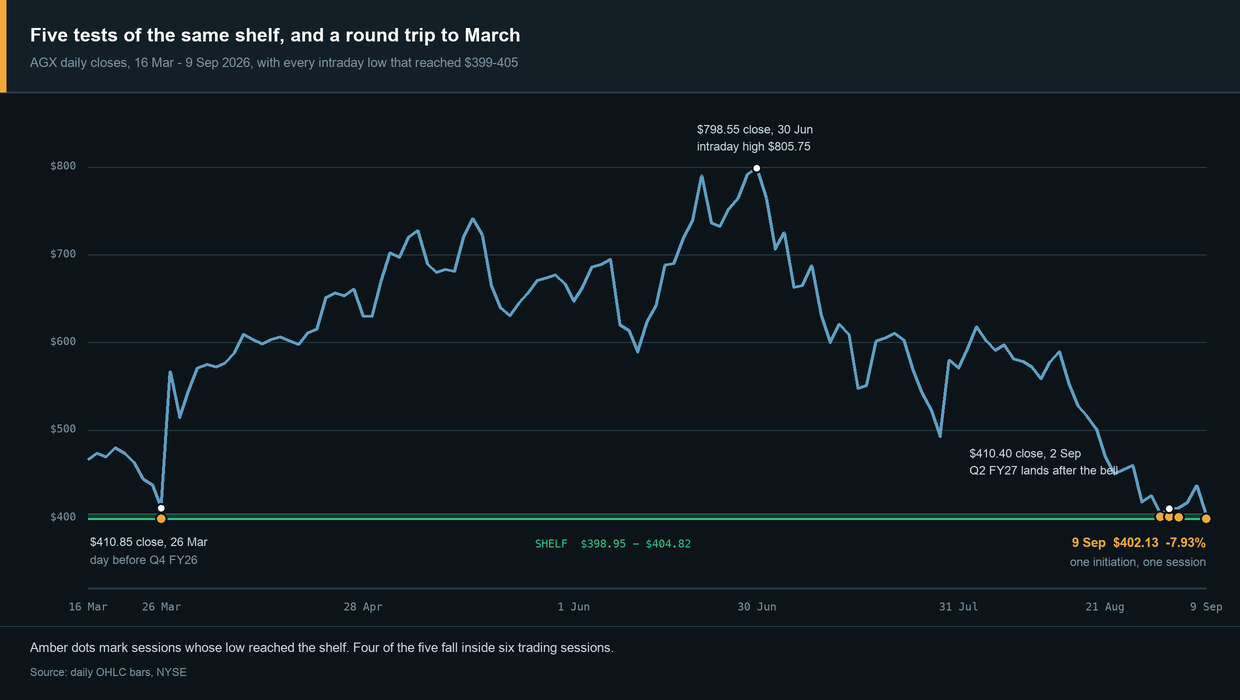
Those five lows read $398.95 (March 26th), $401.51 (September 1st), $401.06 (September 2nd), $400.60 (September 3rd) and $399.25 (September 9th). Wednesday's session travelled from $427.94 down to $399.25 and still closed at $402.13. Buyers absorbed a broker's sell rating plus a 7.93% liquidation and finished on the correct side of the line. That doesn't guarantee the line holds. It does establish, at very low cost, exactly where to find out.
What Argan Actually Builds
Argan is a holding company for four operating businesses. Only one of them really matters to the share price. Gemma Power Systems builds large combined-cycle natural gas plants across the United States. Atlantic Projects Company does that work in Ireland and the United Kingdom. Roberts Company handles industrial field services and fabricates pressure vessels and piping. SMC Infrastructure Solutions runs teledata work, now joined by ValCor Communications, a Connecticut business bought at the end of the second quarter for $8.3m.
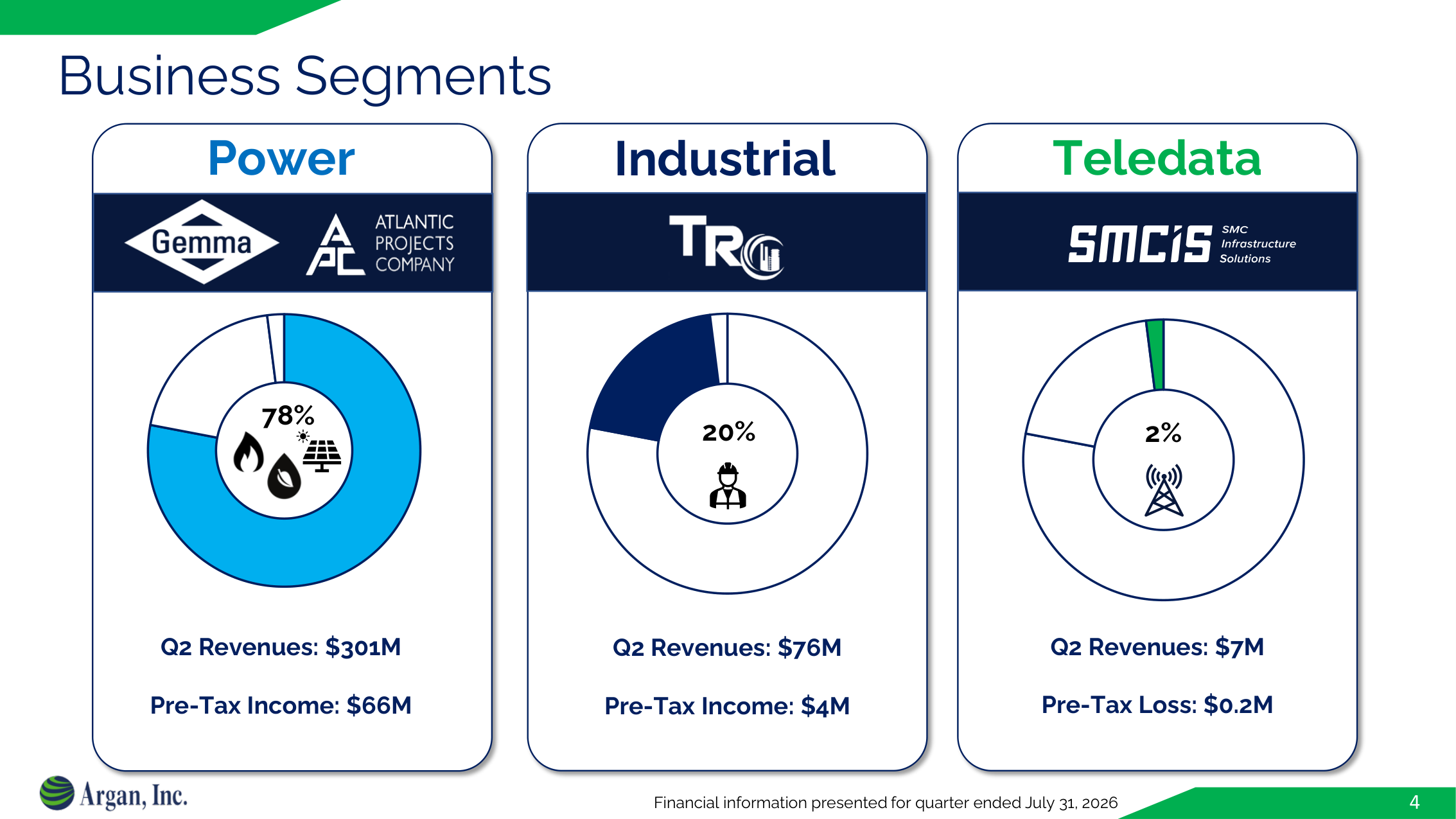
Quanta Services was worth close to $106bn earlier this year and EMCOR ended the June quarter with $17.14bn of remaining performance obligations. Argan is a $5.6bn company with fourteen million shares outstanding and a backlog of $2.5bn. What that buys the holder is purity. Quanta and EMCOR spread the power build across utilities, transmission, mechanical services and data centre fit-out. Argan takes 78% of its revenue from the Power segment, 80% of its backlog from natural gas. Nothing else listed in America offers that concentration. Argan compounds faster than its peers when the cycle runs and falls harder when the market doubts it.
Argan spent $4m of capital expenditure in fiscal 2026 against $944.6m of revenue, four tenths of one percent. SG&A ran between 4.5% and 6.2% of sales. Strip those two away and essentially all of this company's earnings power lives in one line: the spread between a fixed contract price and what it actually costs to build the thing. That is why a gross margin moving from 25% to 19.3% over three quarters took a stock apart, and why the explanation for that move, which comes later, decides more than anything else in this study.
Why is this hard to replicate? A gigawatt-scale combined-cycle plant requires permitting, turbine procurement, gas interconnection, water rights, financing and construction to converge on one schedule. Argan books nothing into backlog until a customer issues a formal notice to proceed. Watson made that consequence explicit on the call: backlog "will move around from quarter-to-quarter related to the completion of certain projects and start time of pending projects." Contracts are overwhelmingly fixed price, so the contractor absorbs the cost overruns and keeps the savings when a job finishes early. That structure creates both margin upside and tail risk. Argan has demonstrated both.
Scale explains why customers keep coming back. Argan's Power backlog currently holds four American gas-fired plants totalling more than 4.1 gigawatts, including a 1,350 MW project for CPV in Texas, the 1,200 MW Sandow Lakes station and an 860 MW thermal plant in ERCOT. Watson's framing of the competitive set was blunt: "there are a limited number of firms, including Argan, who have the capabilities to successfully execute these complex construction projects." Customers awarding this work are not buying construction hours. They are buying the probability that power arrives on the date the hyperscaler contract promised it, and you pay a different price for that.
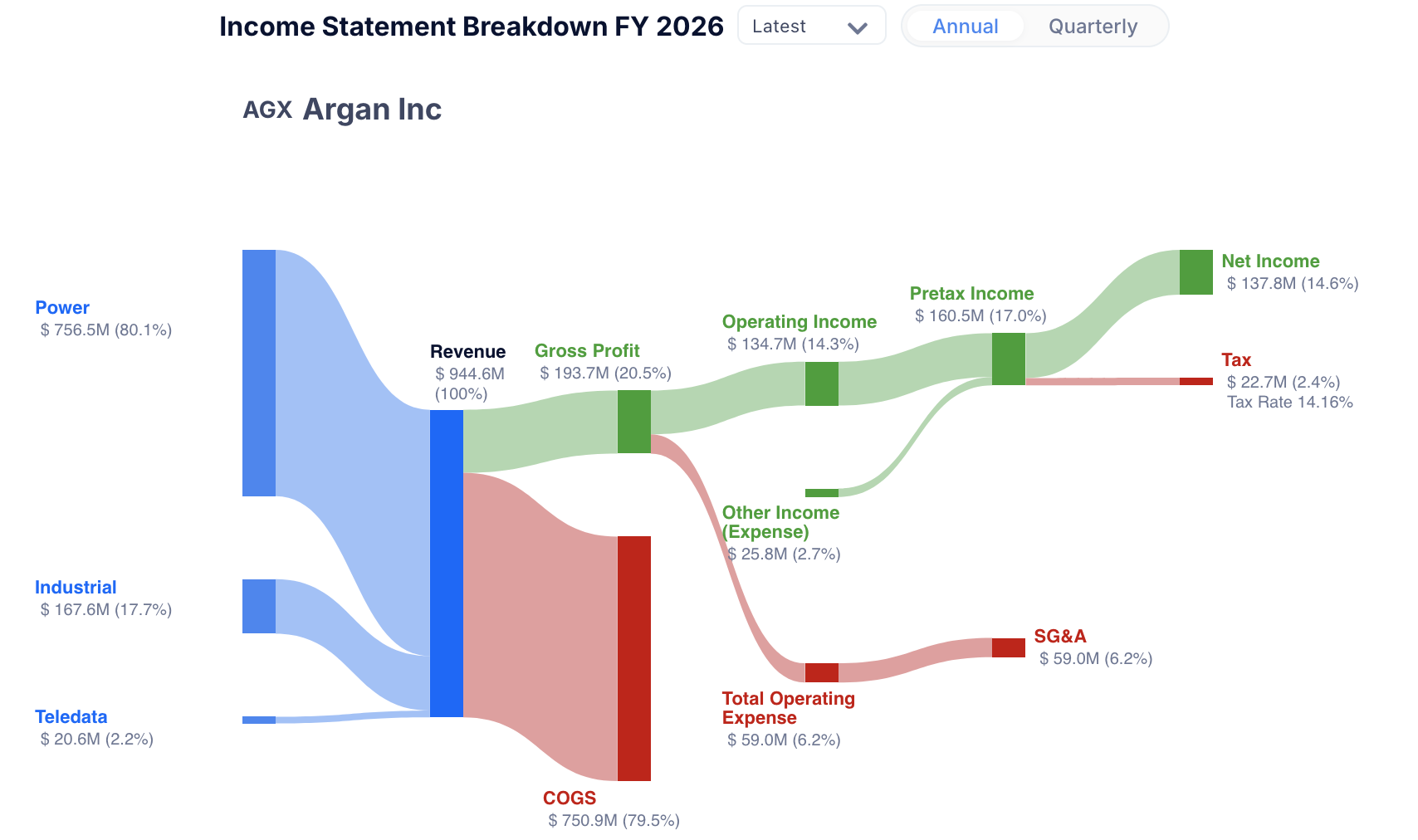
That 20.5% is where Argan separates from everyone else. Everus Construction runs a gross margin of 13.02%, Construction Partners 15.76%, Granite Construction 15.64%. Argan earns 20.5%. Against that peer average of 14.8%, that difference is worth roughly $54m of pre-tax income on fiscal 2026 revenue, or about 40% of everything Argan booked at the operating line. None of those three builds gigawatt-scale combined-cycle plants. That is what the premium pays for. I would rather own the capability than the volume.
Right-hand side of that diagram cuts the other way. Argan's fiscal 2026 net margin of 14.6% was flattered by a 14.16% tax rate that has already begun normalising: second quarter just gone carried $13.6m of tax against $66.9m of pre-tax income, an effective rate of 20.3%. In per-share terms that gap is worth about $0.78 of the $9.74 Argan reported, or 8% of the headline. So the headline looks weaker than the operations underneath it. Pre-tax income in Q2 rose 87.7% year on year while reported net income rose 51.1%, purely because the comparable quarter last year paid almost no tax at all. So reported EPS understates what the operating line did last quarter, and will keep understating it until tax normalises.
Other income deserves scepticism in reverse. That $25.8m is interest earned on a billion dollars of cash, much of which belongs to customers rather than to Argan. Contract liabilities stood at $627.0m at July 31st against $514.0m earlier in the year. Argan is paid in advance to build things, earns yield on the float meanwhile, and returns it as work completes. Nothing improper about it. But when you see the billion-dollar cash headline, halve it in your head. Balance-sheet section below works off net liquidity for that reason.
Reading Past a Record Quarter
Gross margin is the only line that matters on this business. Capex ran 0.4% of revenue last year and SG&A 4.5% last quarter, so earnings have nowhere else to come from. Which makes 19.3% the number to explain, not the record $384m next to it.
Two numbers in that grid point in opposite directions. Revenue grew 61.5% while gross margin fell 570 basis points from where it stood two quarters earlier. Baugher gave a mechanical reason on the call: fourth-quarter and first-quarter margins were flattered by early completions on the Midwest solar and battery portfolio and on Trumbull Energy Center, while June quarter revenue "reflects earlier stage revenues for our current projects in the Power segment."
So margin follows construction phase, not pricing. Watson's forward framing was explicit: "as projects ramp and get into their second and third year of construction, we expect to see higher revenues and with successful execution, we have the opportunity to enhance margin." Argan's four large gas projects started in 2024 and 2025 and complete in 2028 and 2029. All four enter that second and third construction year within this scenario's horizon.
Cost line moved the right way at the same time. SG&A ran 4.5% of revenue against 6.0% a year ago, and 4.9% against 6.2% across the half. That 130 basis point improvement, held across a fiscal year tracking somewhere near $1.35bn of revenue, is worth roughly $18m of pre-tax income, or about a dollar a share after tax. Operating leverage is unusual on a fixed-price contractor. It compounds for as long as revenue does.

Industrial is the blemish. I don't much like it. Gross margin printed 7.3% against 11.8% three months earlier. Watson didn't dress it up: "the margin profile was below our expectations," caused by "a couple of projects unrelated to our data center work where the estimates to complete became below where we initially estimated at project inception." Those jobs wind down over about six months and Industrial margins "may run below historical norms for a quarter or 2." On a segment carrying $76m of quarterly revenue, four and a half points of margin is about $3.4m a quarter. Small. It is also a live demonstration that fixed-price contracts can still produce losses, in a company whose worst year came from that same mechanism.
Everything above is the setup. What follows is the work behind the position, and it is where the argument is actually decided.
- 04 Backlog. why a coverage ratio that fell from 11.8x to 6.6x says less than it appears to
- 05 Award window. three consecutive calls translated from durations into dates
- 06 Balance sheet. which part of the billion belongs to Argan and which to its customers
- 07 Bear case. the same collapse, already run once in Argan's own ledger
- 08 Consensus. a 42% beat that produced a cut to the quarter after next
- 09 Valuation. every multiple recomputed at Wednesday's close, against five named peers
- 10 Technical read. the shelf, the trend, and the level that decides it
- 11 Scenarios. four outcomes, probability-weighted, with the full trade structure
- 12 Catalysts. seven dated events and the three conditions that retire the thesis
Important Disclaimer
This content is for informational and educational purposes only and does not constitute financial advice, investment recommendations, or solicitation to buy or sell any securities. Past performance does not guarantee future results. All investments carry risk, including the possible loss of principal. Shares of Argan, Inc. (NYSE: AGX) are subject to significant risks including: revenue concentration in a small number of very large fixed-price engineering, procurement and construction contracts, where a single cost overrun can offset the profit of several successful projects, as occurred in fiscal 2020; a consolidated project backlog that has declined for three consecutive quarters and that the company recognises only on receipt of a customer notice to proceed; consolidated gross margin that has stepped down in each of the last three quarters; Industrial segment margins management expects to run below historical norms for a further quarter or two; management guidance of limited sequential revenue growth in the third quarter and lower Industrial revenue for the balance of the fiscal year; a stated execution ceiling of ten to twelve simultaneous projects and dependence on hiring and training craft labour; dependence on third-party turbine and equipment delivery schedules; customer permitting, financing and power purchase agreement milestones outside the company's control; regulatory and political developments affecting data centre and gas plant development, including state-level interventions; integration and execution risk in the ValCor Communications acquisition; sustained insider selling with no offsetting open-market purchases over the trailing twelve months; institutional ownership of approximately 98% of the register and short interest of roughly 7% of shares outstanding, which together amplify price moves on a share count near fourteen million; and material dispersion in sell-side estimates and price targets, which currently range from $273 to $800. Argan does not issue formal revenue or earnings guidance. Technical analysis presented reflects historical price and volume data and is not a guarantee of future movements; support and resistance levels, relative-strength readings, moving averages, trend-strength measures, order blocks and Fibonacci retracements are lagging or interpretive indicators with well-documented limitations. Scenario analysis, price targets and probability weightings are based on publicly available information, independent modelling and analyst-consensus data as of September 9th 2026; actual results may differ materially. Entry, target and stop levels reflect scenario-based analysis, not price predictions. Always conduct your own due diligence and consult a qualified financial advisor before making any investment decision. Position-sizing observations are general in nature and do not account for individual circumstances, tax situations or risk tolerance.