Six months ago Kratos Defense sold 16.4 million shares to institutions at $84.00 and raised just under $1.4 billion. Since that morning the company has won a $156 million counter-drone prime contract, taken about $400 million of hypersonic funding from the Department of War, opened a $50 million payload-integration plant ahead of schedule, been handed a $100 million space-domain production award, developed a next-generation seeker for Javelin, and, yesterday, watched its jointly developed engine receive a United States military type designation and a development contract for JASSM. Revenue in June quarter grew 30.5%. Guidance went up twice. Shares trade about a quarter below what those institutions willingly paid on strictly worse information.
Something has to explain that. Demand cannot, and neither can the order book, where backlog reached $2.084 billion with $1.572 billion of it funded. Explanation sits three lines lower in the accounts. Kratos consumed $11 million of operating cash in the quarter and is guided to burn $85-105 million of free cash this year, and a market that spent 2025 paying for growth spent 2026 refusing to pay for growth that costs money.
Look at what the money bought. Of the $250-275 million Kratos is investing in 2026, only about half is capital expenditure. Some $80 million is working capital, and management itemised it: $40-45 million of Zeus and Oriole rocket-motor inventory, $19-21 million of jet-engine production inventory, $13-14 million of drone materials. Those are not speculative purchases. Eric DeMarco was blunt about the rule on August's call: "we don't do a build it and they will come." That inventory is 2027 revenue, bought early, sitting in warehouses. Accounting shows it as a cash outflow today because accounting has no line item for confidence.
So this is a timing arbitrage with an unusually clean anchor. You are buying an enterprise a quarter cheaper than its last audited price discovery, at a point where five months of lower highs have just been broken and price is pressing the one level every chart in front of me marks independently. Two things must hold for it to work: funded backlog has to keep converting, and the 2027 guide due with November's print has to show margin finally moving with revenue. Neither is certain. Both are visible in advance. That is the most a defence-industrial trade ever offers.
Ian Andy, Research Desk, Bellwether Research, August 18, 2026
What Kratos Actually Builds
Start with the company, because most write-ups collapse it into one airframe and then argue about that airframe. Kratos was created on January 1st 2008 out of the wreckage of a telecom-services business, with no revenue and some cash from asset sales. Eric DeMarco has run it since 2004 and Deanna Lund has been chief financial officer for exactly as long, which by defence standards is a geological era. Today it employs more than 5,200 people across 13 countries and reports in two segments.
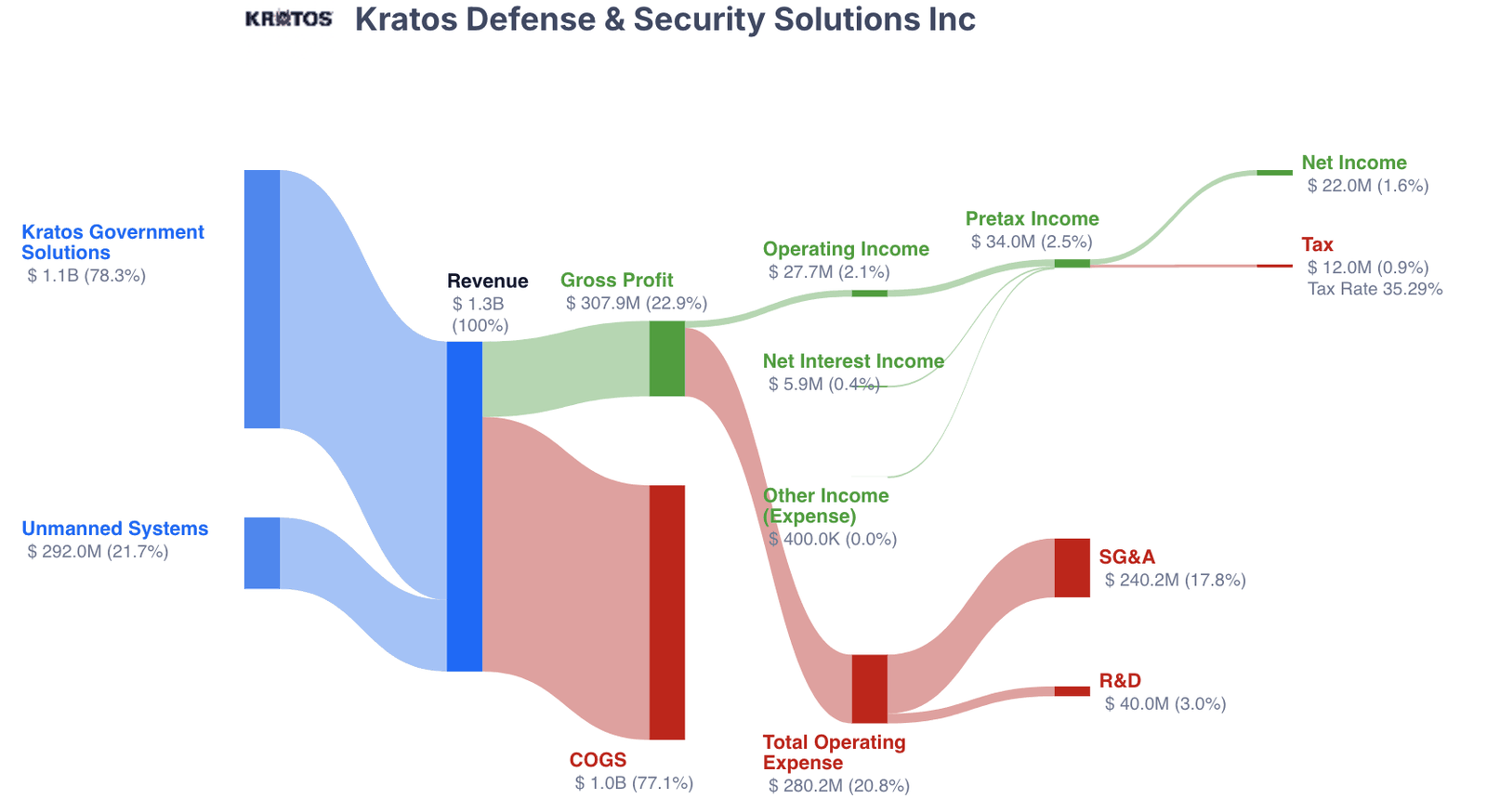
Kratos Government Solutions is the larger segment and where growth lives: $379.7 million of June-quarter revenue, 82.8% of the total, growing 22.0% organically. Inside it sit six businesses that have almost nothing to do with each other operationally and everything to do with each other strategically. Defense rocket and hypersonic support grew 50.2% organically. Turbine technologies grew 43.3%. Microwave electronics, headquartered in Israel and working with Israel Aerospace Industries, RAFAEL and Elbit, grew 29.5%. Space, training and cyber grew 8.7%. Add radar sustainment, C5ISR mobility hardware and directed-energy integration and you have a portfolio of about thirty programs.
Unmanned Systems is the famous half and the smaller one: $79.1 million, 17.2% of revenue, up 8.1% organically. XQ-58A Valkyrie lives here, alongside Mako, Firejet and those BQM-167 and BQM-177 target drones nobody writes about, which steadily bankroll the tactical work. Kratos produces 165 to 170 jet drones a year, which DeMarco believes makes it the largest jet-drone producer in the world outside Ukraine.
"Quantity matters, not just quality," and his evidence is Germany in 1944, which built "the most exquisite weapons in World War II, the first cruise missile, the first ballistic missile, but they couldn't build enough of them. They were overwhelmed by quantity."
Eric DeMarco, President and Chief Executive Officer, Kratos Defense, interview with The American ExecutiveThat sentence is the entire operating philosophy, and it explains a financial statement that otherwise looks broken. Kratos deliberately does not chase the exquisite end of the market. It designs for mass manufacture at a price point the large primes structurally cannot match, funds the development itself, and sells either as a prime where it thinks it wins or as a merchant supplier underneath Lockheed Martin, Northrop Grumman and Boeing where it does not. DeMarco described the future force structure on August's call as a barbell: enormous quantities of attritable munitions and drones on one side, a handful of exquisite systems on the other, very little in between. Kratos sells into both ends and owns neither middle.
Be concrete about how a dollar actually reaches this company, because contract structure explains both the thin margin and the ugly cash flow. Some 67% of second-quarter revenue came from fixed-price contracts, 29% from cost-plus and 4% from time and materials. By customer it was 69% United States federal, 20% foreign and 11% commercial, state and local. Fixed price on physical hardware caps gross margin at 21.8%. A software-led defence name would post 60% or 70%. Kratos is a manufacturer, it carries the overrun risk itself, and no amount of narrative changes that arithmetic.
What it buys with that risk is the design-in. Hold on to that mechanism for the rest of this study. Kratos funds development out of its own pocket, gets its engine or its subsystem specified into somebody else's missile or aircraft, and then earns on every unit that platform ever ships. Development is the entry fee. Production is the annuity. A company running that model will always look worst in the years when it is paying entry fees for programs that have not started shipping. That is precisely the year you are looking at. Once you see the business this way, the cash-flow statement stops being a verdict and becomes a calendar.
One more structural point, because it decides how the next three years look. DeMarco runs six autonomous divisions, each with a long-tenured president holding full profit-and-loss responsibility and its own business-development function. None of those presidents came from a traditional prime. He is explicit about why: "At Kratos, if there are ten decisions to make, we make ten decisions. Eight are good, two aren't. But at least we made ten decisions and didn't miss an opportunity waiting for fifteen committees." In an industry where threat evolution outruns procurement, that is the actual moat. Not a patent. A decision cycle.
Metrics at a Glance
Numbers below are as reported for the quarter ended June 28th 2026, with market data to the August 17th close. Read them as a pair of opposing columns, because that is what they are.
Sit with the last figure for a second, because it governs everything about how this position should be sized. A stock that moves 10% in an average week does not respect a tight stop, and any risk framework built for a 3% mover will be taken out by noise long before the thesis is tested. High risk on the header row is not a formality here.
Anatomy of a 30% Beat
Kratos told the market in May to expect $400 to $410 million of revenue, an operating loss of $6 to $8 million and adjusted EBITDA of $30 to $35 million. It delivered $458.8 million, an operating loss of $1.6 million and $38.2 million. Clearing the top end of your own revenue guide by $48.8 million goes well past a rounding surprise. A company that misjudges its own conversion rate by almost twelve percent in one quarter is telling you how fast the backlog has started to turn. Shares rose 30.4% over the month that followed the print.
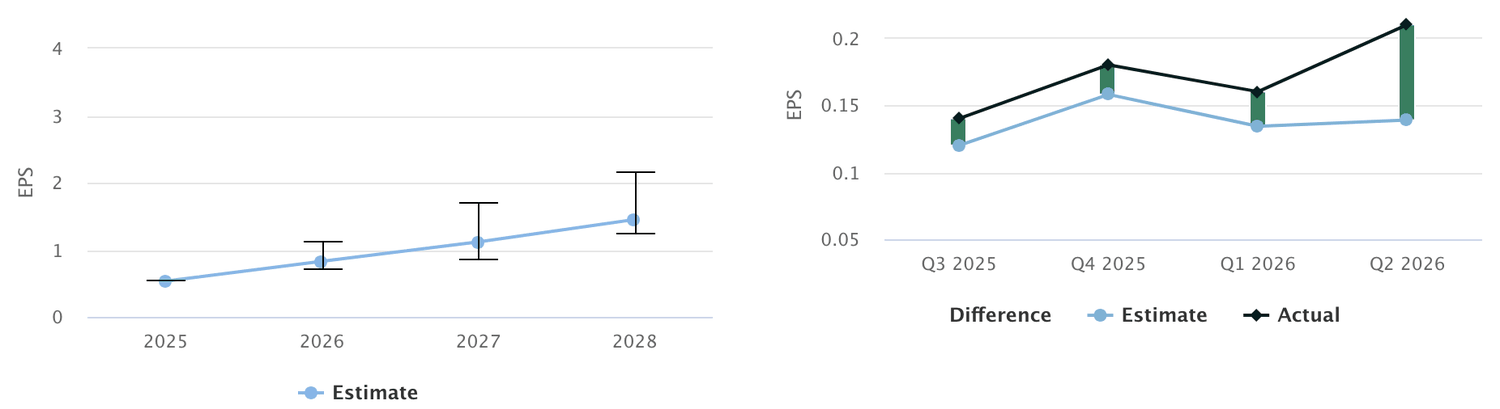
Now do the uncomfortable arithmetic. Reported net income of $4.4 million exists because $10.2 million of interest income on the February cash pile more than covered the operating loss. Strip that and Kratos lost money at the operating line on record revenue. Adjusted earnings per share of $0.21 rests on adding back $16.3 million of stock compensation and $24.5 million of depreciation and amortisation, the latter inflated by the Nomad and Orbit purchases. Both numbers are legitimate under their own definitions. Neither is evidence of a profitable business yet.
| Line | Q2 2026 | Q2 2025 | Reading |
|---|---|---|---|
| Revenue | $458.8M | $351.5M | +30.5%, of which 19.1% organic |
| Gross profit / margin | $100.1M / 21.8% | $73.8M / 21.0% | +80 bps on a heavier product mix |
| GAAP operating income | $(1.6)M | $2.1M | Growth has not reached the operating line |
| Net interest income | $10.2M | n/a | Interest on the February raise |
| GAAP net income / EPS | $4.4M / $0.02 | $2.9M / $0.02 | Positive because of the line above |
| Adjusted EBITDA / margin | $38.2M / 8.3% | $28.3M / 8.1% | +35.0% in dollars, +20 bps in margin |
| Operating cash flow | $(11.0)M | n/a | Working capital and prepayments |
Most coverage stopped here. What follows is where it gets interesting, because guidance moved in two directions at once and almost nobody separated them.
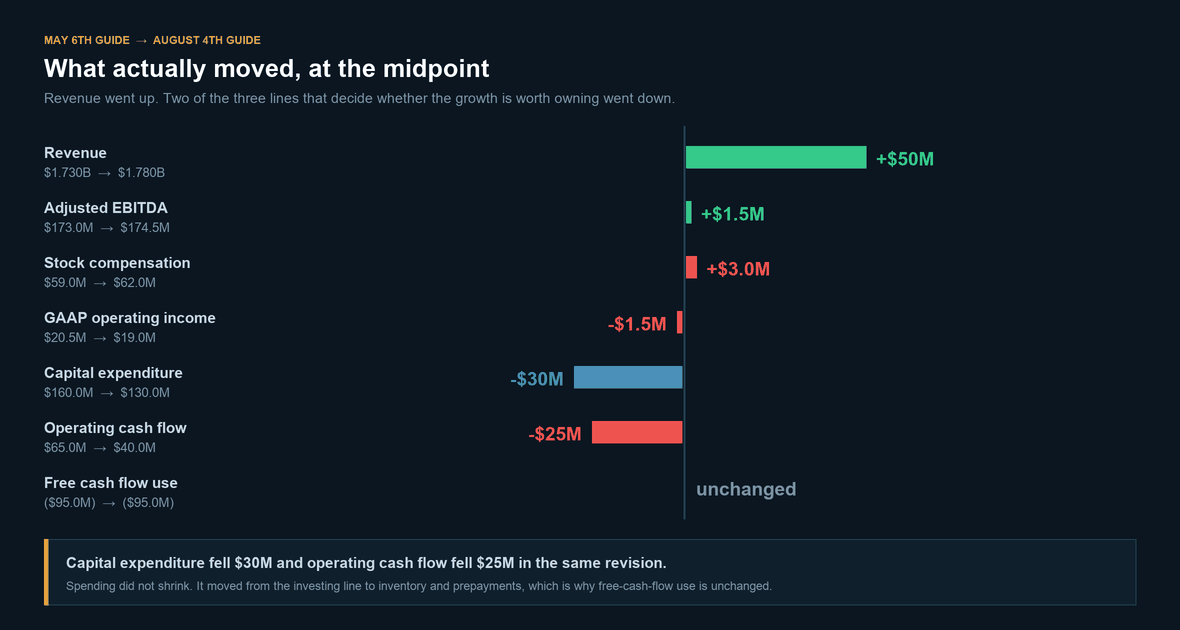
Two negatives survive that reframing. Full-year adjusted EBITDA guidance of $174.5 million at midpoint landed below the $177.7 million analysts carried, so that raise was revenue-only. And a strengthening Israeli shekel cost $2.5 million of EBITDA in the quarter alone, with $5 to $7 million expected for the year, because Kratos bills more than 700 Israeli employees' work in dollars and pays them in shekels. Lund called it "the single most significant headwind from a margin perspective." That is real money and it is not going away this year.
Important Disclaimer
This content is for informational and educational purposes only and does not constitute financial advice, investment recommendations, or solicitation to buy or sell any securities. Past performance does not guarantee future results. All investments carry risk, including the possible loss of principal. Kratos Defense & Security Solutions, Inc. (NASDAQ: KTOS) is subject to significant risks including: dependence on United States government appropriations, continuing resolutions and shutdown risk, with approximately 69% of quarterly revenue derived from federal customers; award-timing and task-order conversion risk on indefinite-delivery contract ceilings, which are opportunity values and not funded backlog; execution and cost risk on fixed-price contracts, which represented approximately 67% of second-quarter revenue; sustained negative free cash flow and working-capital consumption during the current capacity build; dilution risk from equity issuance and stock-based compensation; supply-chain, casting, solid-rocket-motor and qualified-labour constraints on the planned production ramp; integration and impairment risk associated with the Nomad and Orbit acquisitions and the goodwill and intangible balances they created; foreign-exchange exposure, in particular Israeli shekel strength affecting the microwave products business; geopolitical and operational exposure through more than 700 employees based in Israel; and competition from traditional prime contractors and privately funded defence-technology entrants. Technical analysis presented reflects historical price and volume data and is not a guarantee of future movements; moving averages, pivot points, Elliott wave counts, MACD and trend-strength readings are lagging or interpretive indicators with well-documented limitations, and third-party technical data services may publish stale or erroneous values. Scenario analysis, price targets and fair-value estimates are based on publicly available information, independent modelling and analyst-consensus data as of August 2026; actual results may differ materially. Entry, target and stop levels reflect scenario-based analysis, not price predictions. Always conduct your own due diligence and consult a qualified financial advisor before making any investment decision. Position-sizing guidelines are general in nature and do not account for individual circumstances, tax situations or risk tolerance.