TransMedics ran to roughly $150 in February. By the time the dust settled after its May 5th first-quarter print, the stock had given back about 55% and was trading in the low-$60s. What broke? Revenue growth decelerated to 21% year-over-year, the slowest in years, and adjusted operating margin compressed to about 10% of sales. For a name the market had learned to treat as a serial beat-and-raise machine, a single ordinary quarter read like a regime change.
Here is the part the tape is missing. That margin compression was deliberate and pre-announced. Management is front-loading a once-in-a-company-history wave of investment: the OCS Kidney program, a Gen 3.0 device platform, a European National OCS Program with its own dedicated air fleet, a new cold-storage product line called CHOPS, and a 498,000-square-foot headquarters. Strip those out and you still own the only FDA-approved warm-perfusion organ platform on earth, sitting behind roughly 26% of every liver, heart and lung transplant in the United States, throwing off $192.8 million of operating cash flow last year, and guiding to 20–25% growth this year. Flight activity, the cleanest real-time read on case demand, hit an all-time high in the same month the stock bottomed.
Scenario entry zone $60.5–$63.5 corresponds to roughly 3.5x next-twelve-month EV/sales, the cheapest TransMedics has ever traded, versus a historical average closer to 8x and a slower-growing surgical-robotics peer at 13x. GuruFocus flags it in its lowest valuation band since 2022. Wall Street's published average target sits near $117. Market is pricing an investment year as if it were a broken business. That gap is the trade.
Signal Dashboard
Key Metrics at a Glance
Read that grid in two halves. Left of center is the business: a 37% grower in 2025, decelerating to a still-healthy 21% in the first quarter of 2026, sitting behind a quarter of all US thoracic and liver transplant volume, generating real cash for the first time in its history. Right of center is the dislocation: margins guided lower on purpose, a multiple that has fallen to the floor of its own range, and a published analyst target nearly double the current quote.
Worth saying plainly what kind of company this is, because it governs how you read the drawdown. TransMedics is not a binary biotech waiting on a single readout. It sells a commercial product, runs a national logistics network, and collects revenue every time an organ moves. Revenue is real, recurring at the case level, and growing. So when a 37% grower slips to 21% and the stock halves, the question is whether that deceleration is structural or self-inflicted. I will argue, across the sections below, that it is overwhelmingly the latter.
One number anchors the whole thesis. For the full year 2025, TransMedics generated $192.8 million in operating cash flow. A genuinely broken growth story does not produce that. A company spending heavily to pull forward its next three growth engines, while the existing engine keeps running, does. That distinction is the entire argument.
What TransMedics Actually Is
Device, Service, Network – Why This Cannot Be Copied on a Short Timeline
Most investors meet TransMedics as "the company that flies organs in jets" and stop there. That framing badly undersells what has been built. Three layers stack on top of each other, and each one is harder to replicate than the one beneath it.
First, the device. Organ Care System, or OCS, is the only FDA-approved portable warm-perfusion platform for the heart, lung and liver. For sixty years the standard of care was a beer-cooler full of ice and preservation fluid, a method essentially unchanged since the early 1960s. Cold storage suspends an organ's biology and starts a clock: a heart has roughly four hours before accumulated ischemic damage makes it unusable. OCS does something categorically different. It keeps the organ warm, oxygenated and functioning in real time. A liver on OCS produces bile. A heart on OCS beats. An organ on OCS does not know it has left the donor. That eliminates the decay clock, lets organs travel coast-to-coast, and most importantly resurrects organs that cold storage would have forced surgeons to discard.
Second, service. Proving that a device worked was never what stalled adoption. What stalled adoption was operational burden — an individual transplant center could not absorb training perfusion teams, staffing procurement surgeons for 2 a.m. flights, chartering aircraft, and coordinating with its local procurement organization, all on top of an already-stretched on-call schedule. So in 2022 TransMedics built its National OCS Program, or NOP, and took that entire operation onto its own balance sheet. A center calls NOP. NOP sends a surgeon and a clinical specialist, manages perfusion, arranges logistics, and delivers a living, assessable organ to a waiting operating room. Revenue went from $30 million in 2021 to $93 million in 2022 once a constraint on adoption was removed.
Third, the network. In 2023 TransMedics acquired a charter operator and began building a dedicated fleet of Embraer Phenom 300E jets flown only for organ transport. Wall Street hated it; medical-device investors did not sign up for jet fuel and FAA compliance. They missed the point. Owning the aircraft converted unpredictable spot-market charter costs into a fixed asset the company controls, and turned logistics from a ceiling on growth into a moat. By the end of 2025 the fleet stood at 22 aircraft covering roughly 82% of NOP air missions.
"Our vision has always been bold and growth-oriented... we've been deliberate yet aggressive in our strategic investment in growth initiatives. We believe that 2026 is a critical and transformational year that stands to cement TransMedics' near, mid- and long-term growth trajectories... we fully expect that our financial performance over the next several quarters will reflect these necessary investments in people, infrastructure and technology development."
Waleed Hassanein, M.D., Founder & CEO — Q1 2026 Earnings Call, May 5, 2026Sit with that quote, because it pre-frames every margin number you will read in this tip. Management told investors, in advance and on the record, that they were going to spend now to capture later. Per company data drawing on national registry figures, between 2022 and 2025 US liver, heart and lung transplant volume grew about 25%; without OCS and NOP, management says it would have fallen roughly 1%. A 26-point swing in the national trajectory of a system that had crawled for decades.
Why has no Medtronic or J&J replicated this? Because the product and the service are inseparable, and large device companies are not built to run a 24-hour command center, employ more than fifty transplant surgeons, and operate an airline. TransMedics ran nine FDA pivotal trials to get here. A competitor showing up today with a perfusion box and retrospective data is not two years behind. On the Level-1 clinical evidence alone, they are closer to two decades behind. Founder-analysts call the combination of device, clinical service and owned logistics the "TransMedics Trident" ... three prongs a domestic rival has to match simultaneously, not one at a time.
Why This Market Still Exists
Why This Market Still Exists – Discards, Dialysis, and a $40B Bill
Sizing this opportunity means sizing waste. American transplant medicine, for all its sophistication, was engineered to manage scarcity, not to overcome it. Clearest evidence of that sits in one organ: kidney.
As of late 2024, roughly 90,000 Americans were waiting for a kidney, by far the longest list of any organ. In 2024, procurement organizations recovered more than 25,000 kidneys from deceased donors and discarded over 9,200 of them. One in four recovered kidneys went in the trash, a discard rate that has climbed more than 80% in five years. Those discards are logistical, not medical: by the time an offer reaches a willing center, the cold-storage clock has run too far. A National Academies study found that roughly 62% of kidneys discarded in the United States would have been transplanted in France, the same organs, lost to a slower system rather than a sicker population.
Behind the waitlist sits a fiscal monster. The 90,000 people waiting are mostly on dialysis, which costs Medicare $50,000–$90,000 per patient per year; the end-stage renal disease program runs north of $40 billion annually, roughly 6–7% of the entire Medicare budget for under 1% of beneficiaries. A successful transplant frees a patient from dialysis for a decade or more. So when CEO Waleed Hassanein says that in every meeting with the Centers for Medicare & Medicaid Services the first question is "when is the OCS Kidney arriving?", he is describing a payer that is structurally desperate for what TransMedics is building.
Why does this matter for a 9–12 month trade rather than a ten-year thesis? Because it tells you the runway is not the constraint. TransMedics handled about 5,139 US cases in 2025 against a near-term ambition of 10,000 by 2028, and a kidney program that addresses a pool larger than heart, liver and lung combined. A business one-third of the way into its own stated target, trading at a trough multiple, is the setup that creates asymmetric entries. That long-term story underwrites the near-term margin of safety.
Q1 2026 Earnings Read
A 21% Growth Quarter, a 55% Drawdown – Reading May 5th Line by Line
Let me walk through the May 5th print without spin. First-quarter revenue came in at $173.9 million, up 21% year-over-year and 8% sequentially. US transplant revenue was $167 million, growing 20%; international, still tiny, was $5.6 million but up 39%. By organ: liver $139 million, heart $26 million, lung just $2 million. Product revenue $108 million (+22%), service revenue $66 million (+19%), logistics inside that at $32 million (+22%). Adjusted operating profit of about $18.1 million, roughly a 10.4% margin. Cash ended the quarter at $462 million.
Two things spooked the market. Growth had been running 30–40%+ for years; 21% felt like a ceiling arriving. And adjusted operating margin, which touched the high teens in 2025, fell to about 10%. Gross margin slipped to roughly 58%, down 331 basis points from a year earlier. Put those together and a market conditioned to serial beats decided that the story had changed.
Q1 income statement, right from a 10-Q
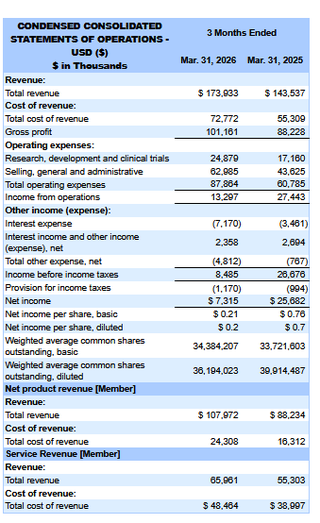
Most useful read of that comparison is what stayed positive. Gross profit still expanded by roughly $13 million in absolute dollars despite the headline margin slip — meaning the business above the operating-expense line is still scaling cleanly with revenue. Every basis point of net-income compression sits below gross profit, in the deliberate step-up of R&D and SG&A. So when the bear case is framed as "earnings missed," the more accurate framing is: TransMedics chose to take $14 million of incremental operating profit and redeploy it into kidney, Gen 3.0, European NOP and CHOPS in a single quarter. Even after that deliberate redeployment, operating income, net income and diluted EPS all stayed positive. A company funding three new growth platforms simultaneously while still printing positive net earnings is a very different story than the headline "EPS miss" suggested.
Service revenue trend – a demand signal under a headline
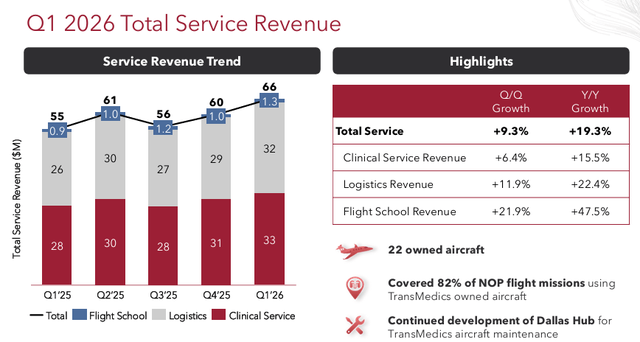
This slide is the antidote to the headline panic. Service revenue is the line of TransMedics' P&L most directly tied to NOP case volume — clinical service plus logistics plus flight school — and every single sub-line accelerated in the same quarter the headline number decelerated. All three sub-lines printed double-digit YoY growth, and clinical service plus logistics combined now run at roughly the same dollar pace as net product revenue. Fleet coverage of NOP missions also ticked higher quarter-over-quarter, meaning more of every incremental case is captured inside TransMedics' own logistics economics rather than paid out to third-party charter. Read that way, the part of the business that scales with actual transplant adoption kept compounding through the very quarter the market priced as deceleration.
Earnings Quality and Cash
Earnings Quality – Margin Optics, Tax Noise, Real Cash
Headline numbers tell you what happened; the next four exhibits tell you whether it actually means anything. Walking the prior-quarter baseline, the GAAP margin trend, two transient headwinds, and the cash statements together is how you separate a business that is breaking from one that is spending on purpose. My read, across all four, is the latter.
Q4 2025 baseline – what an engine was doing one quarter earlier
What this prior quarter shows matters because it sets up how to read the bear case. Q4 had operating margin expanding by roughly six percentage points year-on-year on top-line growth above 30% — clean, visible operating leverage. Q1 then reset that picture. So when bears say "margins peaked," what they actually saw was a company that was clearly extracting leverage in Q4 and then chose to spend it in Q1. That is deliberate sequencing, not a deteriorating business. Same chart also reinforces a structural point on the business: liver carried the operating engine then, just as it did in Q1, and heart and lung are still single-digit-share programs waiting for their pivotal-trial catalysts to fire.
Quarterly trend in margin, GAAP
Honest read of that chart sits in the black bars, not the red line. Revenue stepped up quarter-over-quarter in every period shown, including in Q1 — the quarter the market priced as a deceleration event. Net-margin line is contaminated: Q4'25 looks dramatic because of a one-time tax benefit, Q1'26 looks weak because of a one-time investment ramp. Strip both distortions out and what remains is a top line that has not stopped expanding. For a thesis built on the gap between business trajectory and stock trajectory, that is the only series that matters.
Two non-structural headwinds management called out
Two genuine, non-structural headwinds also showed up in the quarter. First, deceased-donor numbers across the country ran below last year, which Hassanein tied to disruption from the US Transplant Modernization Act as procurement organizations register displeasure with proposed reforms. His read: "we don't expect this to be a chronic thing... when it reverses, it will bounce — not just bounce back to baseline, but we expect some acceleration." Second, ENHANCE Heart and DENOVO Lung contributed nothing because enrollment timing pushed their impact out. Twenty-one percent growth was achieved with two of management's nearest catalysts sitting at zero.
Critically, management reiterated full-year guidance of $727–$757 million, 20–25% growth, and noted they were already taking share in Q1 despite the soft donor backdrop. A single ugly print did not move the annual frame. As one bull on the name put it after the quarter, "when fundamentals go one way and the stock goes the other, investors should become greedier." That is the dislocation this tip is built on.
Cash flow during an investment quarter
What I look for here is durability, not magnitude. Across all three quarters shown, operating cash flow stayed positive even as investing outflows grew with the build. That sequence is the answer to the most natural bear concern — that an investment year forces a return to equity raises or expensive debt. It does not. Investment quarters are funded from operating cash and a $462 million cash position, with the convertible-note maturity not landing until 2028. Management's path points to free-cash-flow breakeven around late 2026 and a positive turn into 2027, and the trajectory on this chart is consistent with that.
Balance sheet – liquidity to carry an investment quarter
Cash flow tells you the build is self-funded; the balance sheet tells you the runway. TransMedics closed Q1 with $462 million of cash, against gross debt that is almost entirely a single 1.5% convertible note maturing in 2028 — net of that cash, net leverage is negligible, well under $60 million, and none of it comes due for years. So the bear question of "can the company actually afford this" has a clean answer at the close of Q1: yes, without needing to tap external capital. That leaves dilution as the genuine balance-sheet risk worth tracking, and I take it on directly in the bear section.
Financial Anatomy and Valuation
Financial Anatomy & Valuation – Cheapest It Has Ever Been
When a quality compounder halves, I find it useful to step off forward multiples and look at the actual flow of dollars. Then take that flow against history, peers, and what the market is currently willing to pay. Below is that walk, FY 2025 picture first.
Where each FY 2025 dollar went
Walk that flow. Revenue of $605.5 million, with liver alone at $460.5 million, more than three-quarters of total revenue. Cost of revenue of $242.7 million leaves $362.8 million of gross profit at a 59.9% gross margin. Out of that, $185.2 million went on selling, general and administrative (about 31% of revenue, cost of a direct sales force and clinical staffing) and $69.1 million on R&D (about 11%, kidney and Gen 3.0 build-out). Operating income landed at $108.6 million, an 18% operating margin on a full-year basis. Reported net income of $190.3 million flatters that picture: it includes an $82.8 million one-time deferred-tax benefit, which is why effective tax rate prints negative and why GAAP net margin reads an eye-catching 31%. Strip out tax and underlying operating engine is the honest number to anchor on.
A few observations jump out. Liver concentration at 76% is both a strength and a risk: it is the proven engine, and also why a single weak donor quarter shows up so visibly in the consolidated line. R&D at 11% of revenue is about to rise as kidney and Gen 3.0 programs peak — that is the margin dip, by design. And gross margin sitting at 60%, dragged by lower-margin logistics and service mix, is exactly the line management expects to recover as fleet utilization improves through the double-shifting initiative.
Multiples – cheapest on every relevant lens
Let me lay the multiples out. At the scenario entry zone of roughly $62, TransMedics trades near 3.5x next-twelve-month EV/sales against management's own 2026 guide — a figure the SA Quant grid below corroborates at 3.74x forward. Its own historical average sits closer to 8x. Intuitive Surgical, the canonical regulated-moat surgical-robotics compounder, trades around 13x while growing more slowly than TransMedics did in 2025. On non-GAAP earnings the stock changed hands near 39x at $114 earlier this year; at the entry zone that compresses to roughly 21x. Whichever lens you pick, this is the cheapest TransMedics has been on a sales basis since it became a scaled business.
Worth pausing on this grid because it captures something a single multiple cannot, and because it has materially changed shape since the drawdown. Versus TransMedics' own five-year history, every sales-based and cash-flow lens now runs 60–77% cheaper than the company has historically traded: EV/Sales TTM at −72.5%, EV/Sales FWD at −68.7%, P/S TTM at −76.9%, P/S FWD at −74.2%, P/Cash Flow TTM at −60.5%. PEG on trailing GAAP earnings grades A at 0.07. And here is what the post-drawdown picture shifted: TMDX has crossed from D− headline territory into C+, and on a handful of lenses — P/E GAAP TTM, P/S TTM, and P/S FWD — it now trades at an outright discount to its sector median rather than a premium. Combination of "dramatically cheap versus self" plus "now also cheap versus the sector on those lenses" is the rarest valuation setup this name has offered since it became a scaled business.
One grade on that card stands apart, and it deserves more than a passing glance: PEG, the single lens where TransMedics earns an outright A against its sector. PEG, price/earnings multiple divided by the growth rate, is the number that refuses to let you judge a multiple in isolation. A 30x P/E reads expensive until you learn earnings are compounding 30%, at which point PEG lands near 1.0 and the "expensive" label quietly dissolves. Below 1.0 means the market is charging you less than a single point of multiple for each point of growth: Peter Lynch's classic growth-at-a-reasonable-price signal. I will be honest that the headline 0.07 reading is flattered by the same one-time deferred-tax benefit that inflated trailing GAAP earnings, so do not anchor on the decimal. But rebuild it on normalized earnings and forward growth and the growth-adjusted multiple still lands right around 1.0, under it on the faster end of the 20–25% guide, against a sector median sitting far higher. That gap is what the A grade is flagging.
Why fixate on this one lens out of the dozen around it? Because PEG is the rare number that speaks to both halves of the market at once. To a growth investor, a sub-1 reading says the 20–25% compounding is being handed over underpriced ... you are not overpaying for the runway, which is the cardinal sin in growth investing. To a value investor, it supplies the margin of safety a bare P/E or EV/Sales never can: the multiple is not merely low versus the company's own history, it is low relative to what the business is actually growing into. Growth buyers and value buyers almost never bless the same ticker. PEG is the spot on this grid where, for once, they shake hands, and it is doing so while every richer earnings-based lens still flashes red, which is precisely the tension a patient entry is built to exploit.
GuruFocus' fundamental fair-value model tells that same story from a different angle. Price has fallen well below the GF Value line, into the deepest discount band on the chart, a first such reading since the 2022 base. I never anchor on a single model, but a quality-adjusted fair-value framework flagging a company this deep into its undervalued zone, with no deterioration in the underlying franchise, is worth noting.
EPS path – trough this year, recovery to 2028
Earnings estimates show why patience is required and why the payoff sits in the out-years. Consensus EPS is expected to trough this year, near $2.05 against roughly $2.60 in 2025, then recover to about $3.60 in 2027 and $5.08 in 2028 as the investment year rolls off and new engines contribute. That trough-and-recover shape is the earnings signature of exactly the kind of year management told investors to expect.
Sell-side – where analysts sit
Sell-side framing supports an entry here without my having to lean on it. Of analysts polled by S&P Global, consensus rating is "Buy" with an average twelve-month target near $116.78, a median of $120, a low of $75 and a high of $142. Against a low-$60s quote, that average implies roughly 70% upside and even the lowest published target sits above the entry zone.
Rating mix has barely flinched through the drawdown. A Barron's-tracked panel showed Buy ratings holding at 8 of roughly 12 (with one Overweight and three Holds, zero Sells) across three months into May, consensus "Buy" throughout. Published targets tell the same story: even Oppenheimer's recent downgrade to Hold carried a $175 target, while Canaccord ($124) and TD Cowen ($120) both reiterated Buys well above the scenario entry zone. When a stock falls this far with its rating distribution intact, sell-side conviction has not broken with the price.
Triangulating to my own target. Apply a conservative 6x NTM EV/sales to the midpoint of 2026 guidance, well below the 8x historical average, and you land in the low-$100s. Push toward the historical 8x on 2027 revenue and you clear $160. Base-case scenario target of $109–$115 sits deliberately below the consensus average and the historical multiple ... a "partial re-rating" target, not a heroic one. It asks only that the market stop pricing an investment year as a structural break.
Live demand vs. trough valuation – dislocation in one chart
One last chart to close the valuation picture, and it sits outside the income statement entirely. Flights per month are the closest thing to a live feed of NOP case demand, because almost every transplant in the program involves a mission. Activity dipped through the summer 2025 seasonal slow patch, then pushed to all-time highs through the first five months of 2026, including the very month the stock bottomed. Set this on top of every multiples chart above and the dislocation has its cleanest expression: a live operating signal at a 15-month high, layered against a valuation signal at a multi-year low. That gap is exactly what the scenario entry zone is built to harvest.
Liver Engine and Free Options
A Liver Engine, and Three Programs You Are Paying Almost Nothing For
Useful way to think about TransMedics today: two companies wearing one ticker. One is mature, profitable and compounding, other has barely started.
Company one is liver. Liver transplants and services drive the overwhelming majority of revenue, more than 80% of sales in the most recent quarters, growing 27% year-over-year in Q1 even as it became the base everyone measures against. US liver share sits around 36%, and management is adamant the runway is long. On the prior call Hassanein pushed back hard on the idea that liver is tapped out: "we are very, very much believers that the notion that growth in liver is going to be difficult to come by, we believe that's a false assumption, propagated by the wrong narrative." Growth from here comes from deeper penetration of both donation-after-brain-death and the harder donation-after-circulatory-death organs that only warm perfusion makes practical.
Company two is everything else: heart, lung and kidney, each at a wildly earlier stage. Heart is roughly $26 million a quarter and climbing. Lung is a rounding error at $2 million, with about 2% national share. Not because the technology fails, but because lung has never had its pivotal superiority trial. Kidney does not exist commercially yet. A fair way to frame it is that heart and lung today sit roughly where liver sat five years ago, and kidney is a few years behind them.
Why does this matter for valuation? Because at the entry zone, the liver business alone broadly supports the price. As one analyst put it after the most recent results, "the liver company alone more than justifies the current valuation, which means investors are getting the Lung, Heart, and Kidney programs essentially for free." I would not call them entirely free at $62, but I would call them deeply underpriced options. And the option that matters most over the next year is the one nobody is modeling: lung.
Lung at 2% share is not a market in decline. It is a market that has been waiting for a catalyst. DENOVO is the first superiority trial in the history of lung transplantation, a direct claim that OCS beats the best available cold-storage alternative, rather than merely matching it. If it delivers, the same adoption dynamic that drove liver from single digits to 36% share becomes available to a franchise operating today as if the trial were perpetually about to begin. Hard to handicap the odds. Easy to see that the market is currently assigning that optionality a value of approximately zero.
Growth Engines
What This Investment Year Is Actually Buying
Every dollar of the margin compression that scared the market is funding one of five initiatives. Understanding them is understanding why the dip is temporary rather than terminal.
ENHANCE Heart and the CHOPS solution. ENHANCE is the heart program designed to expand OCS across donor types and unlock morning-hour and extended-criteria heart transplants. Part A is enrolling slightly ahead of schedule. Part B stalled, though, for an unusual reason: a competitor refused to let its cold-storage device serve as the comparator arm. Rather than wait, TransMedics built its own FDA-registered active-cooling device, CHOPS, to serve as a clean control. Hassanein's framing was blunt: today's "cold storage" often means surgeons "going to Home Depot and buying either YETI coolers or RYOBI coolers" with no validation whatsoever, and CHOPS replaces that with a regulated device offering controlled 4–12°C preservation. FDA reportedly called the workaround "a creative and elegant solution." IDE supplement was filed within weeks of the May 5th call, with approval and implementation expected in early Q3 2026.
CHOPS as a product, not just a control arm. Here is the part the market under-appreciated. TransMedics intends to file a separate 510(k) to sell CHOPS commercially. Hassanein is explicit it is additive, not cannibalistic: it targets the segment of short-run, donation-after-brain-death hearts currently going to cold storage that OCS does not address today. He quantified it on the call: of 4,646 US heart transplants in 2025, about 2,131 were brain-death hearts preserved under four hours, a pool where TransMedics' share is in the single digits. CHOPS, delivered through the NOP network, is a way to monetize a market the company was previously locked out of. A company built to kill cold storage just built the best cold-storage device in existence, and turned its biggest clinical obstacle into a new revenue line.
"CHOPS is not cannibalizing anything. CHOPS is tackling a segment of the market, specifically DBD hearts that are like 2 hours of preservation that are not being used [on OCS] today... it's additive to our market share."
Waleed Hassanein, M.D., Q1 2026 Earnings Call, May 5, 2026OCS Kidney on the Gen 3.0 platform. This is the big one. Kidney is the largest segment of the transplant market, and roughly 9,000 discarded DCD kidneys a year in the US represent pure incremental volume. Kidney will launch first on the new Gen 3.0 platform — smaller, lighter, lower part count, designed for automated assembly and, crucially, remote clinical monitoring that removes the specialist who currently flies with every organ. A working prototype is targeted for the American Transplant Congress in Boston in late June 2026, with a US IDE submission in early 2027. Capture even a fraction of that discarded-kidney pool and you roughly double the company's current case volume.
Gen 3.0 across liver, heart and lung. That same redesign rolls into existing organs, lowering build cost and supply-chain dependence. This is the engine of the margin recovery: Gen 3.0 plus remote monitoring flows straight to service margin without any change in price or volume.
Europe and PAD Aviation. TransMedics is replicating the NOP abroad, starting with four hubs in Italy and a partnership with PAD Aviation, a German charter operator that already flies the identical Phenom 300E aircraft. Paderborn sits within one to two hours' flight of every major European transplant hub. Management says Europe could "nearly double" the addressable market, with the Netherlands and Belgium next. None of this is in the numbers yet; it begins to contribute in late 2026 and meaningfully in 2027.
There is also a wildcard worth naming: the Transplant Modernization Act. TransMedics has filed detailed comments with CMS arguing that entities with national infrastructure, including for-profits, should be allowed to bid for the donor-service regions of decommissioned procurement organizations. If CMS agrees, the company intends to submit bids later this year or early next, potentially turning itself into a vertically integrated transplant utility that captures the procurement fee directly. Long-dated and uncertain, but free optionality at this price.
Bear Case Steel-Manned
Sell Thesis – Five Arguments and My Read
I will not strawman the bears, because the most rigorous bear case on this name is genuinely well-built. One analyst has held a Sell through the whole decline, and after Q1 his discounted-cash-flow model still pegged fair value near $69, arguing the stock bakes in near-perfect execution even after falling ~40%. Worth noting his own number sits above my entry zone, but the argument deserves a real hearing. Below are five vectors. Four I think the evidence neutralizes. One earns an honest partial concession.
"Valuation still implies a near-impossible combination: sustained double-digit revenue growth AND double-digit free cash flow margins at the same time. A DCF still pegs fair value around $69 even after a 40% drop."
This is the strongest bear point and the reason the stop sits where it does. But the entry zone matters: at $60.5–$63.5, the trade is being put on below the bear's own $69 base case, not above it. Growth-plus-margin tension is real for a richly valued stock, but it binds far less once the multiple has already compressed to 3.5x sales. My thesis here does not require both levers to max out, only that growth holds near 20% (guided, and the line both bulls and bears watch) while margins normalize on the schedule management has already laid out. He is right that perfection was priced at $130. At $62, mediocrity is priced.
"This is now an 'airplane company.' Owning 22 jets caps free cash flow structurally — some organs just need a beer cooler and a one-hour van ride, not a jet, a pilot and a perfusion machine."
Half-true and self-defeating as a bear point. Yes, a segment of short-run organs does not need warm perfusion and TransMedics just built CHOPS precisely to serve that segment through the same logistics network, converting the bear's objection into a new revenue line. On the fleet, owning aircraft turned volatile charter spot pricing into a controllable fixed cost and removed a hard ceiling on NOP growth. Double-shifting lifts utilization on those same 22 planes without buying more, which is margin-accretive by construction. That aviation build is why FY2025 produced $192.8M of operating cash flow, not in spite of it.
"Shareholder dilution is relentless. Share count rose ~16% in 2025 and could run another ~15% in 2026. Even at a flat price, the market cap keeps inflating."
Fair, and the one I concede partially. Dilution is real and it is the cleanest reason to size this position with discipline. A genuinely bullish holder has to accept that per-share value gets diluted while the business funds itself. Two mitigants: the company is now operating-cash-flow positive, which reduces the need to issue equity going forward, and the convertible note structure (1.5%, due 2028) is cheap capital, not a fire sale. My own falsification line is explicit. If 2026 dilution runs north of 20%, the per-share math weakens enough that I would step back regardless of the operating story. Watch the share count every quarter.
"Growth levers are weak. Kidney barely needs warm perfusion (kidneys keep in cold storage), international is slow and capital-intensive, and the OPO-conversion thesis is a long-dated bet on federal rulemaking nobody can predict."
Each lever is hedged, not load-bearing alone. Kidney's prize is not preservation time, it is the ~9,000 DCD kidneys discarded annually, incremental volume in the largest transplant segment, and CMS is structurally motivated to see it work given the $40B dialysis bill. Europe is slow, yes, and explicitly modeled as a 2027+ contributor, not a 2026 crutch. OPO-conversion idea I treat exactly as the bear does: a free call option, valued at zero in the base case. Thesis does not need any single one of these to fire within 12 months. It needs the existing liver engine to hold and a multiple that normalizes. These levers are upside, not floor.
"Fuel costs and donor disruption are eating the model. An Iran-driven oil spike taxes a fleet-heavy business, and the Modernization Act is suppressing donor numbers right now."
Both are real but contained and likely transitory. On fuel, Hassanein was pointed: "we're not United Airlines or Delta... fuel charges is a small component of our operating flight hour cost," and transplantation has grown through high-oil and low-oil decades alike because the market recovers the cost. On donors, the dip ties to procurement organizations registering displeasure with reform; management expects it to reverse and historically to overshoot to the upside afterward. A wider, sustained Middle East escalation that kept oil elevated for many quarters would be a genuine headwind to monitor. But the base case is normalization, and TransMedics still printed 21% growth through the worst of it.
Three Scenarios
Three Scenarios – Probability-Weighted Outcomes
Each scenario anchors on next-twelve-month EV/sales applied to the relevant revenue base, with a 9–12 month holding period from a ~$62 scenario entry midpoint. Probabilities are rough by design; spurious precision would be worse than honest rounding.
Probability-weight those three and the expected value lands near $108 against a ~$62 entry, roughly 74% expected return over the horizon. Shape of that payoff is what makes the entry attractive: the conservative case still produces a positive return because the liver business plus a clean balance sheet anchor a floor in the $70s, while the base case asks only for a partial multiple recovery toward, not all the way to, consensus average. A bull case requires the catalysts to actually fire, which is upside I am not paying for at the entry.
Let me be explicit about what would change my view. If year-over-year revenue growth slips below 20%, the line management itself defends and the bulls treat as the floor of the story, the deceleration starts to look structural rather than investment-driven, and I would step back. Same if 2026 shareholder dilution runs north of 20%, if free-cash-flow breakeven slips well beyond early 2027, or if the ENHANCE, DENOVO and kidney timelines slip materially as a group. None of those are flashing today. They are the dials I will watch over the next three quarters to keep the thesis honest.
Catalyst Roadmap
Catalyst Roadmap – What Moves TMDX Over 12 Months
This thesis does not rest on one binary event. It plays out as a sequence of datapoints that each narrow the gap between what the stock prices and what the business delivers.
Technical Picture
Capitulation Read – Where Demand Sits
Fundamentals build the thesis; technicals tell you whether now is the moment. In this case the chart does real work, because it marks the zone where a year of selling pressure has exhausted itself and where risk and reward invert.
Read this chart top to bottom. Price peaked near $150 in February, then stair-stepped lower through the spring before the post-earnings flush drove it into the low-$60s. It now trades well below both its 50-day moving average and its 200-day moving average and that 200-day line, currently anchored near $104, is the exact level my key-levels table calls out as Resistance 2 and the lower edge of the scenario target zone. In other words, the chart is telling you that reclaiming the 200-day SMA is the trade. An extended condition this far below the long-term mean rarely persists without a mean-reversion attempt. Lower panel is the tell: RSI compressed into the low-20s during the capitulation, got reset, and has begun ticking up, a sequence associated far more often with exhaustion lows than with the start of fresh downtrends. And those volume bars show a clear spike on the decline, the fingerprint of forced, indiscriminate selling rather than measured distribution.
Pair that with the GuruFocus picture from the valuation section: price sitting in its lowest valuation band since 2022. When a deeply oversold momentum reading lines up with a multi-year valuation trough and a fundamental story that has not actually broken, that is the convergence I look for. Technicals do not call the exact bottom, and they are lagging by construction. But they tell you the scenario entry zone of $60.5–$63.5 sits where structural demand, valuation support and momentum exhaustion overlap.
Path back is legible. First friction sits near $85, the zone the stock sliced through on the way down. Above that, the reset 200-day moving average near $104 is the gateway into the scenario target zone of $109–$115. None of the path requires a new all-time high. It requires the stock to reclaim levels it traded at three months ago.
Trade Scenario
Trade scenario – Execution Protocol
Following scenarios reflect the author’s personal analysis and are not investment recommendations. See our full disclaimer.
TransMedics at the $60.5–$63.5 scenario entry zone offers a rare alignment in medical technology: the cheapest sales multiple in the company's history, a deeply oversold technical setup, a fundamental quarter that grew 21% with two major catalysts contributing nothing, $462 million of cash against minimal net debt, and a management team executing a pre-announced investment year rather than reacting to a broken one. Setup is asymmetric. What it asks of an investor is discipline on sizing (this is a volatile, dilutive growth name) and the patience to hold across the 9–12 months the catalysts need to land.
- ENTRY > Build in two tranches. Tranche 1 (60% of intended position) across the $60.5–$63.5 scenario entry zone. Tranche 2 (40%) on either a deeper flush toward the $54–$56 area, or on the first weekly close back above $70 to average in with confirmed momentum.
- SIZE > 2–4% of a diversified equity portfolio fits this High Risk classification. TMDX is a volatile, dilutive, single-product-concentrated growth name; anchor toward the lower end unless you have specific conviction and tolerance for drawdown. Size for the dilution, not just the upside.
- TP1 > Trim 25–30% of the position into $84–$88. That zone reclaims the level the stock sliced through on the way down and bands with the bear-side targets; a reasonable place to lock initial profit if the recovery stalls before the year-end catalysts.
- TP2 > Trim a further 35–40% into the $109–$115 scenario target zone. This is the base-case midpoint, below the consensus average, and the level where natural re-rating supply tends to appear.
- TP3 > Hold the final 30–35% with a trailing stop below the prior monthly low. In the bull scenario (ENHANCE/DENOVO progress, kidney momentum, a raised guide), let it run toward $140+ as the engines re-rate.
- STOP > Hard stop on a sustained weekly close below $51.5. Below that level the market is telling you growth has slipped structurally below 20%, dilution has overwhelmed the per-share story, or the investment year is not converting. Thesis no longer holds.
- MONITOR > Quarterly: year-over-year revenue growth (sub-20% is the yellow flag), share count and dilution pace (north of 20% annualized is a red flag), gross margin trajectory (Q1 should be the floor), free-cash-flow path to breakeven, ENHANCE/DENOVO enrollment, and kidney IDE timing. Monthly: flight activity, RSI, and reclaim of the $85 and $104 levels.
Core Thesis - Three Sentences
- TransMedics owns the only FDA-approved warm-perfusion organ platform, sits behind ~26% of US liver/heart/lung transplants, generated $192.8M of operating cash flow in 2025, and trades at the cheapest sales multiple in its history after a ~55% drawdown.
- That drawdown reflects a deceleration to 21% growth and a margin dip that management pre-announced and is funding on purpose — OCS Kidney, Gen 3.0, European NOP, and CHOPS — not a structural break in the underlying business, which kept taking share and hit record flight activity through the quarter.
- Even the conservative scenario returns positive from the entry because liver value plus a clean balance sheet anchor a floor in the $70s; the base case to $109–$115 needs only a partial multiple recovery toward the consensus average, not a heroic re-rate.
One last thought, the part that does not fit in a multiples table. This is a founder-led company twenty-eight years into a single mission, run by a surgeon who has raised guidance at least ten consecutive times without a cut and who used the Oppenheimer conference to say, plainly, "we are still in early to mid-innings... I stopped counting" the beats. I do not take CEO quotes as gospel. But when a management team tells you in advance that it is going to depress margins to build its next three growth engines, then does exactly that, and the market reacts as if the engines themselves had failed, the disconnect is the opportunity. Looking at the cash flow, the share gains, and the flight data, I think the business is fine and the price is wrong.
Analyst Note, Bellwether Research Desk, May 16th 2026
Important Disclaimer
This content is for informational and educational purposes only and does not constitute financial advice, investment recommendations, or solicitation to buy or sell any securities. Past performance does not guarantee future results. All investments carry risk, including the possible loss of principal. TransMedics Group, Inc. (NASDAQ: TMDX) is a high-growth medical technology company subject to significant risks including: revenue concentration in liver transplantation; dependence on continued adoption of the Organ Care System and the National OCS Program; clinical and regulatory risk on the ENHANCE Heart, DENOVO Lung, CHOPS, and OCS Kidney programs and any FDA or international approvals; execution risk on international expansion and the PAD Aviation partnership; aviation operational risk including fuel-price exposure, pilot availability, and FAA compliance; sensitivity to US transplant policy, the Transplant Modernization Act, OPTN reform, and reimbursement dynamics; meaningful and ongoing shareholder dilution; quarter-to-quarter seasonality and variability in donor volumes; near-term operating-margin and free-cash-flow compression from front-loaded investment; and general macroeconomic sensitivity as a long-duration growth asset. Technical analysis presented reflects historical price and volume data and is not a guarantee of future price movements. RSI and moving-average signals are lagging indicators with well-documented limitations. Scenario analysis and price targets are based on publicly available information, independent modelling, and analyst consensus data as of May 2026; actual results may differ materially. Always conduct your own due diligence and consult a qualified financial advisor before making any investment decision. Position-sizing guidelines are general in nature and do not account for individual circumstances, tax situations, or risk tolerance.