Health Care - Health Care Services

HIMS - From GLP-1 Disruptor to Global Health Platform: Novo Partnership, 2.5M Subscribers & Valuation Reset in Progress

Hims & Hers Health, Inc. (NYSE: HIMS)
April 10, 2026 9-12 Months Moderate-High Risk
Outlook
Bullish
Time Horizon
9-12 Months
Scenario Entry Range
$19-$21
Target Zone
$34-$40
Risk / Reward
1 : 2.5
Health Care Services Intelligence Briefing April 10, 2026 | Bellwether Research
STATUS ACTIVE - BULLISH
TIER Health Care Services / Large Cap Growth
ASSET HIMS - NYSE
MKT CAP ~$4.8B
ENTRY ZONE $19.00 - $21.00
TARGET ZONE $34.00 - $40.00
STOP LOSS $14.50
CLASSIFICATION Platform Re-Rating / Narrative Shift

The market has spent last eighteen months pricing Hims & Hers as a regulatory accident waiting to happen - a telehealth company making aggressive bets on compounded GLP-1 drugs while the FDA circled overhead. That thesis is now structurally broken. The March 2026 partnership with Novo Nordisk didn't just remove the overhang. It flipped the narrative entirely. Hims moved from being a disruptor fighting pharma to pharma's distribution channel.

What I find most interesting is what the market still refuses to price in: a $2.35 billion revenue platform growing 59% year-over-year, with 2.5 million subscribers, $83 average monthly revenue per user, and a management team that just presented Wall Street $2.7-$2.9 billion in 2026 guidance. The stock trades at roughly 1.6x forward sales. For a company growing above 25% with visible margin expansion ahead that multiple, I do not see a premium, I see a discount.

01

Hims & Hers at a Glance

$2.35B FY2025 Revenue
+59% YoY Growth
2.5M+ Subscribers
$83 Monthly ARPU
$318M Adj. EBITDA
$300M Operating Cash Flow
65% Personalized Plans
~$4.8B Market Cap

Andrew Dudum founded Hims & Hers in 2017 with a simple bet...that most people would rather manage their health from a phone than sit in a waiting room. Hair loss treatment was the entry point. A clean brand, affordable pricing, direct-to-consumer subscriptions. Skeptics called it a vanity play. They were wrong.

Eight years later, Hims runs one of the largest telehealth platforms in the United States. Company operates across sexual health, dermatology, mental health, weight management, hormone optimization, and - as of late 2025 - its own diagnostics lab infrastructure. It ended FY2025 with over 2.5 million subscribers and generated $2.35 billion in revenue, up 59% year-over-year. From startup to full stack platform.

But you wouldn't know that from the stock price.

What management has been saying openly, the numbers show. In latest shareholder letter, they put the FY2026 outlook front and center. Here is exactly what they guided the market to expect.
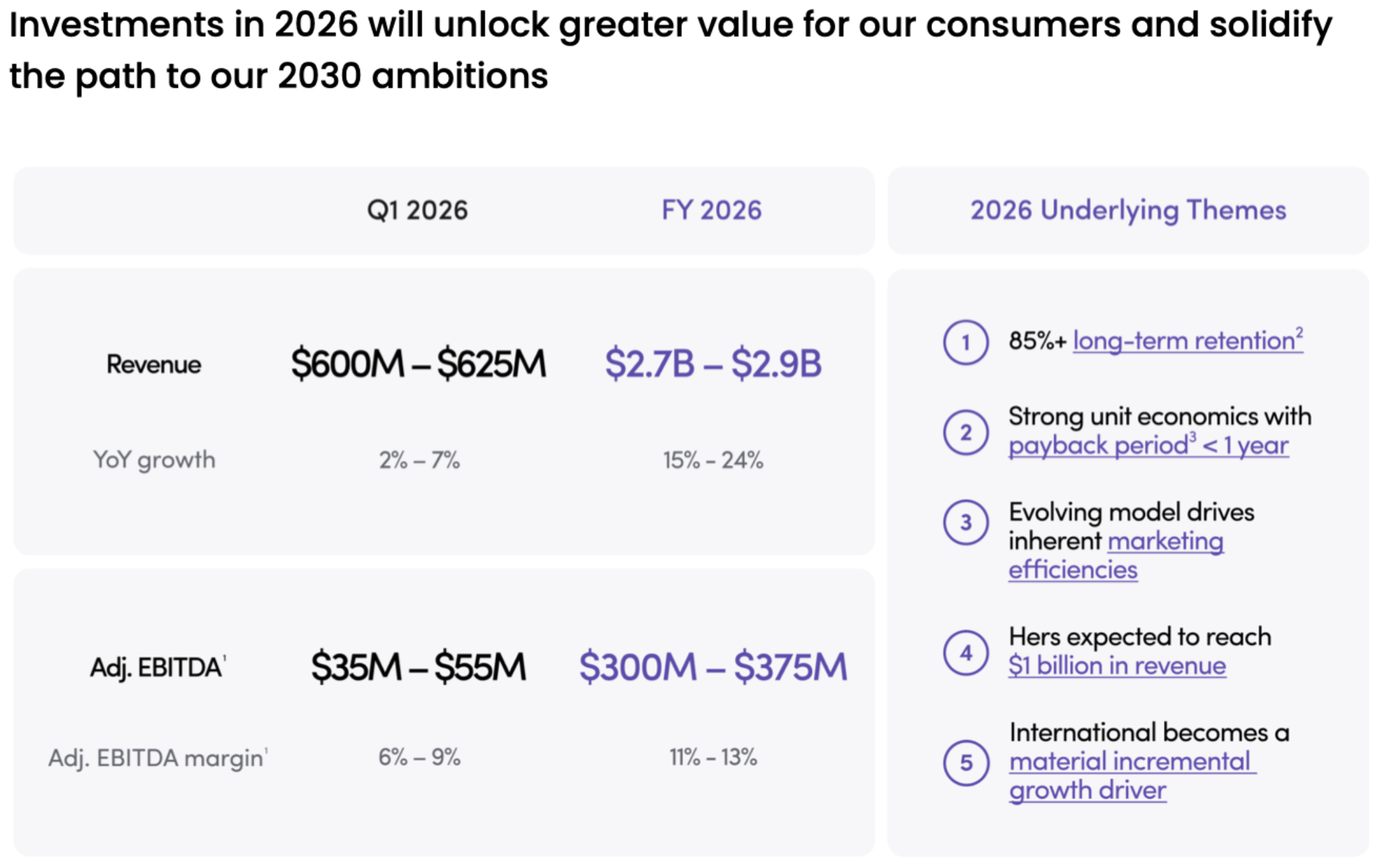
Hims & Hers FY2026 outlook from Q4 2025 shareholder letter showing revenue and adjusted EBITDA guidance
Hims & Hers FY2026 outlook - management is guiding toward $2.7-$2.9B in revenue and $300-$375M in adjusted EBITDA, with full-year adjusted EBITDA margin expected between 11% and 13%. The range accounts for the GLP-1 category transition from compounded to branded products. Source: Q4 2025 Shareholder Letter
02

The Platform Nobody Wants to Understand

I keep coming back to one thing when I look at Hims. The market doesn't understand what this company actually is. Or maybe it does, but it's choosing not to price it.

Most analysts still categorize HIMS as a telehealth company. That was accurate in 2020. It is not in 2026. What Hims has built, while GLP-1 noise consumed every headline, is a consumer health subscription platform with expanding lifetime value and declining marginal acquisition costs. That distinction matters enormously for valuation.

Here is what I mean. A user comes to Hims for finasteride - hair loss. The acquisition cost is paid once. That user then discovers the platform offers testosterone therapy, or dermatology consultations, or mental health prescriptions, or weight management. Each additional service increases revenue per user without increasing the acquisition cost. Average monthly revenue per subscriber hit $83 in Q4 2025, up meaningfully from prior years. 65% of subscribers are now on personalized treatment plans. That is a multi-product regimens that lock in higher ARPU and lower churn.

This is brand new healthcare company, much closer to a subscription-based consumer platform with healthcare as the vertical. Think of it this way: Netflix acquired you for one show, then kept you for the library. Hims acquires you for one condition, then keeps you for the platform.

"Over 65% of our subscribers are now on personalized solutions. These are multi-condition, multi-product treatment plans that drive significantly higher lifetime value and meaningfully lower churn rates."

- Andrew Dudum, CEO, Q4 2025 Earnings Call (Feb 23, 2026)

Core Health Categories

~$1.8B+
Foundation Revenue
Sexual health, dermatology, mental health - the high-margin backbone that generates cash to fund new category expansion

Weight Management

GLP-1 Transition
Novo Partnership Live
Shifting from compounded to branded Wegovy & Ozempic distribution. Lower margin, higher legitimacy, massive TAM

Emerging Verticals

Labs + Hormones
New Revenue Streams
At-home diagnostics, testosterone therapy, menopause care - each a billion-dollar TAM that compounds the platform flywheel

What CEO Andrew Dudum described at the Morgan Stanley TMT Conference in March 2026 is a company that selects new categories with surgical precision. Criteria? The condition must be chronic (recurring revenue), underserved by the existing healthcare system (demand pull), and treatable through a combination of telehealth and pharmacy fulfillment (operational leverage). Every new vertical that meets these criteria expands the platform without expanding the cost base proportionally.

2030 targets tell the story management is building toward: $6.5 billion in revenue, $1.3 billion in adjusted EBITDA, and a 20% EBITDA margin. Those are ambitious numbers. But they are not fantasy, they are math. If ARPU continues rising and subscriber growth holds in the mid-teens, compounding does the work.

03

The Novo Nordisk Pivot - From Adversary to Ally

Let me be direct with you. The Novo Nordisk partnership is the single most important event in the history of this company. Not just because of the immediate revenue impact, that will take quarters to fully materialize. But mainly because it fundamentally changes what kind of company Hims is.

For the last year, conversation around HIMS has been dominated by one question: can this company survive the regulatory crackdown on compounded GLP-1 drugs? FDA was circling. Novo Nordisk had filed lawsuits. Compounding pharmacies that supplied Hims with semaglutide were operating in a gray zone that could close at any moment. It was, frankly, the most legitimate bear case against the stock.

That bear case is now dead.

In March 2026, Hims and Novo Nordisk announced a partnership under which Hims will become an authorized distributor of branded Wegovy and Ozempic. Lawsuits were dropped. The compounded products will be discontinued. Hims transitions from a regulatory target to a pharmaceutical distribution partner.

Stock moved 40% in a single session. That tells you how much overhang was embedded in the price.

But here is what I think most people are missing. Financial impact of this deal is secondary to the psychological and strategic impact. Why would Novo Nordisk - a $400 billion pharmaceutical company - partner with a firm it was actively suing? Answer is simple: because Hims has something Novo wants. Distribution. Access. A direct-to-consumer platform with 2.5 million engaged health subscribers.

Novo isn't doing Hims a favor. Novo is solving its own problem. GLP-1 demand is supply-constrained, and Novo needs every distribution channel it can get. Hims offers something traditional pharmacy chains don't...a digitally native customer base that is already engaged in health management, already providing data, already subscribing monthly.

Margin profile changes, yes. Distributing branded Wegovy is less profitable per unit than selling compounded semaglutide. But trade-off is sustainability over margin. A regulatory-proof revenue stream replacing a regulatory-fragile one. For a long-term investor, that is the right trade every single time.

"This partnership represents the natural evolution of our platform. We built the consumer relationship, the clinical infrastructure, and the fulfillment capability. Now we're pairing that with the world's leading branded GLP-1 therapies."

- Andrew Dudum, CEO, on the Novo Nordisk Partnership Announcement (March 2026)
04

Financial Execution - Numbers Behind the Noise

Strip away the GLP-1 headlines and short-squeeze speculation. What do the numbers actually say? They say this is a company executing at a level that most growth-stage businesses would envy.

FY2025 revenue came in at $2.35 billion, up 59% year-over-year. That's the third consecutive year of accelerating growth. Adjusted EBITDA hit $318 million. Operating cash flow reached $300 million. Gross margin has expanded from 29% in early years to roughly 74% in recent quarters. Let that number sink in. A healthcare platform generating software-like gross margins.

HIMS Adjusted EBITDA trajectory FY2020 to FY2025 showing inflection from losses to $318M profit
Adjusted EBITDA trajectory FY2020-FY2025 - from negative $30M and -11% margin at the 2021 trough to +$318M and +14% margin in FY2025. Inflection point was FY2023. Acceleration since has been uninterrupted. Source: Q4 2025 Shareholder Letter

Look at the EBITDA chart and you see something rare for a consumer health platform at this stage: a clean, monotonic inflection. FY2020 through FY2022, the company was a cash burner. FY2023 crossed into profitability. FY2024 more than tripled the base. FY2025 nearly doubled it again, from $177 million to $318 million. That is three consecutive years of the EBITDA number being the story, not the revenue number.

And margin expanded alongside it. 12% in FY2024 to 14% in FY2025, on revenue that grew 59% in the same window. Operating leverage does not get cleaner than that. Every marginal dollar of revenue is arriving at a higher incremental margin than the average. That is the signature of a business where the fixed-cost base has been built and the subscriber flywheel is doing the compounding work.

HIMS Q4 FY2025 financial results summary from shareholder letter
Q4 FY2025 results summary - record revenue of $481M in Q4 alone, with EBITDA margins expanding as operating leverage kicks in. Hims & Hers is able to push OPEX down in parallel with grow of its subscriber's list. Source: Q4 2025 Shareholder Letter

Q4 2025 alone generated $481 million in revenue. Subscriber count crossed the 2.5 million mark. And the metric I watch most closely - average monthly revenue per subscriber - climbed to $83. That number has been moving in one direction for eight consecutive quarters. Up.

What the ARPU trajectory tells me is that the cross-selling engine is working. Plus, data shows users aren't signing up for one product and sitting there, they're constantly adding services. They're moving from a $30/month finasteride subscription to a $120/month personalized multi-product plan that includes hair loss, skin care, and hormone therapy. Economics of that shift are profound - same customer, same acquisition cost, four times the revenue.

HIMS FY2026 outlook and guidance from shareholder letter
FY2025 Subscribers & Revenue evolution - Management guidance for FY2026 showing confidence in growth trend continuing. Range accounts for GLP-1 transition timing. Source: Q4 2025 Shareholder Letter

For FY2026, management is guiding toward $2.7 to $2.9 billion in revenue and $300 to $375 million in adjusted EBITDA. The wide EBITDA range reflects the transition uncertainty - how quickly branded GLP-1s ramp versus the ~$65 million headwind from discontinuing compounded products. But even the low end of that range implies continued revenue growth above 15%, and the high end implies growth north of 23%.

CFO Yemi Okupe laid this out clearly at Morgan Stanley conference in early March. Investment cycle in infrastructure, personalization technology, and international expansion is peaking. What comes next is operating leverage. Fixed costs are largely built. Incremental revenue drops through at higher margins. That is when the earnings story inflects.

"We've invested heavily in the infrastructure - fulfillment, pharmacy, technology, AI-driven personalization. That investment cycle is maturing. What you should expect going forward is improving operating leverage as revenue scales against a more stable cost base."

- Yemi Okupe, CFO, Morgan Stanley TMT Conference (March 2, 2026)

Two more numbers deserve attention and neither gets the coverage they should. Operating cash flow of $300 million against $2.35 billion of revenue puts cash conversion above 12%. That is a ratio most growth-stage consumer businesses cannot produce until years after their IPO. Hims is producing it while still growing revenue at 59%. Standard trade-off between growth and cash generation is not operating here.

Second, look at the quality of the subscriber book itself. 2.5 million paying subscribers. 65% of them already on personalized, multi-product regimens. Monthly ARPU at $83 and rising each quarter. Churn trending down as multi-product attachment locks users in. Does no feel like a volatile consumer list that needs to be re-acquired every year. Rather a recurring-revenue book with expansion revenue embedded in the same customer cohort. Analysts applying consumer discretionary multiples to HIMS are using the wrong comparison set. The right comparison is recurring-revenue subscription businesses, and those trade at materially higher multiples than the current stock price reflects.

One more read on the operating leverage story. Q4 2025 generated $481 million in revenue against an implied cost base that has been built for a company running at a materially larger scale. As revenue climbs into the $2.7-$2.9 billion band guided for FY2026, fixed cost absorption improves on every incremental dollar. That is the math behind why EBITDA margin has gone from 6% to 12% to 14% in three consecutive years without any step-change in the business model. Same model, more scale, better absorption. This is how platforms compound.

Pull back and look at all five lines together. Revenue scaling. Margin expanding. Cash converting. ARPU rising. Subscriber base compounding. Each one moving the right direction. All of them moving at once. That is the rare setup most analysts pay lip service to but rarely see in practice, and it is why I keep coming back to the same conclusion: market is pricing this company as if something is about to break, while the operating data says the opposite.

HIMS FY2025 revenue flow Sankey diagram - $2.35B revenue through gross profit, operating expense, SG&A, R&D, and net income
Simple visualisation of how Hims & Hers makes its money (with FY2025 financial data). Source: BW
05

Going Global - The Eucalyptus Bet

Most investors are still modeling Hims as a U.S.-only story. That is also already outdated.

In late 2025, Hims announced the acquisition of Eucalyptus, Australia's leading digital health platform, for approximately $1.15 billion. Deal is expected to close by mid-2026 and immediately gives Hims a foothold in Australia, UK, Germany, and Japan - markets where direct-to-consumer telehealth is still in its infancy.

Some see this as a speculative international play. Eucalyptus is already generating meaningful revenue. It operates under multiple brands across these geographies and has built the regulatory relationships, pharmacy networks, and clinical infrastructure that would take Hims years to replicate from scratch. Playbook is clear: acquire the infrastructure, overlay Hims brand and technology, and scale.

Okupe was explicit at Morgan Stanley conference about how they think about international margins. Early-stage markets will run at lower margins as the company invests in brand building and regulatory compliance. But the unit economics in mature international markets should converge toward U.S. levels over a 3-5 year horizon. International TAM for categories Hims serves - sexual health, dermatology, weight management - is multiples of the U.S. opportunity.

I'd flag one thing investors are underappreciating: Eucalyptus acquisition gives Hims a beachhead in Japan, world's third-largest healthcare market by spend. If company can replicate even a fraction of its U.S. success in Japan, revenue contribution could be material by 2028.

Look at what Hims actually acquired and the logic sharpens. Eucalyptus is not a single brand, it is a portfolio of category-specific brands. Juniper leads in women's weight management. Pilot leads in men's health. Each brand is already the #1 or #2 player in its local category across Australia, with an expanding footprint in the UK and Europe. Hims bought established market leader in the same verticals they already sell into in U.S.

Product fit is almost frictionless. Weight management in particular is an immediate overlap, Juniper is the largest DTC weight loss brand in Australia, and GLP-1 distribution framework Hims just built with Novo Nordisk maps directly onto Juniper's existing patient base. Two platforms, one drug-access framework, one shared personalization stack. That is a textbook cross-border synergy, not an aspirational one buried in an acquisition deck.

2030 target management keeps referencing, $6.5 billion in revenue and $1.3 billion in adjusted EBITDA, becomes much more plausible once international is in the mix. Baseline U.S. growth at 15-20% annually gets you roughly $4.5 billion by 2030. Gap to $6.5 billion is roughly $2 billion, which is exactly the scale of international revenue a successful Eucalyptus integration, overlayed with Hims product breadth and personalization technology, can plausibly generate on that timeline. International line is the engine within 2030 model.

There is a second-order benefit the market is pricing at zero. International expansion gives Hims a regulatory and supply-chain diversification it has never had before. Today, any adverse U.S. regulatory action, whether on telehealth prescribing, on compounding, or on direct-to-consumer marketing, hits 100% of revenue. Post-Eucalyptus close, a growing share of the revenue base sits under different regulators, with different supply chains, in different currencies. A GLP-1 shortage in the U.S. would no longer be a full-company event. Risk diversification at revenue level is a form of value creation that does not show up in next-quarter estimates but shows up in multiple over time.

What I watch for in next four quarters...first, regulatory pathway for overlaying Hims' personalization technology stack into the Eucalyptus brands, particularly in jurisdictions like UK and Germany where clinical protocols differ from Australia. Second, whether international ARPU begins lifting as multi-product plans get introduced into the Eucalyptus customer base. A lift from Eucalyptus' current single-category ARPU to anything approaching Hims' $83 monthly run-rate would be material on its own. Third, whether a second international transaction follows within 18 months. Management has framed Eucalyptus as a beachhead, not an endpoint. A follow-on deal in Europe or Latin America would confirm that international is the real growth engine through 2030, not U.S. GLP-1 ramp everyone is still focused on.

06

Short Interest - Pressure Building Beneath the Surface

Let's talk about elephant in the room. HIMS has one of the highest short interest levels of any mid-cap in the market right now. Roughly 83.3 million shares, or approximately 40% of float, are sold short. At first glance, this looks like a textbook short squeeze setup. Volatile stock, high short interest, clear catalyst narrative. But I don't think it's that simple.

Reality beneath the surface is more nuanced - and more interesting. Days-to-cover ratio has expanded from 1.0 to 3.6 in recent trading sessions. That means same level of short interest is now significantly harder to unwind. Exit hasn't changed, but it has narrowed considerably.

HIMS short interest percentage of shares outstanding
Short interest as a percentage of shares outstanding - HIMS maintains elevated short positioning at ~40% of float, creating significant squeeze potential on fundamental catalysts. Source: Fintel

Here is what changed. During the sell-off, short volume was running at 62-64% of daily trading volume. Aggressive, conviction-driven shorting. In recent sessions, that number has dropped to approximately 45%. Shorts haven't covered, but they've stopped pressing. That's a meaningful shift.

The way I read this...bear thesis hasn't broken, but it has narrowed. Shorts are no longer betting on regulatory collapse, that risk has been largely removed by the Novo deal. What they're betting on now is execution disappointment. They need GLP-1 transition to stumble, Eucalyptus integration to falter or ARPU growth to stall. That is a much thinner edge than "FDA will shut them down."

I think about who controls the next move in this stock. And increasingly, that control is shifting from technical positioning to fundamental validation. Trigger for a short squeeze - a real one, not a meme-driven spike - is a move above the $30 level sustained by earnings delivery. If HIMS reports a strong Q1 2026 with visible GLP-1 ramp, math for shorts becomes very uncomfortable very quickly.

07

Technical Structure - SMA Convergence and a Double Test

I generally lead with fundamentals. But technical picture here is too interesting to ignore.

HIMS is currently experiencing a positive price action setup involving two critical moving average tests. 50-day simple moving average sits at approximately $19.72, and the 200-day SMA at roughly $33.55. Stock is currently trading near the 50-day SMA - testing it from below after the post-Novo pullback. This is the first test. A successful reclaim of the 50-day SMA would signal that correction from $27 spike is stabilizing and that a new base is forming.

Second test - and the one that matters more - is the 200-day SMA overhead at $33.55. That level sits squarely within our target zone. A move toward and through the 200-day SMA would confirm a structural trend reversal and likely trigger significant short covering. Convergence of these two tests creates a clear technical roadmap: reclaim the 50, consolidate, then attack the 200.

HIMS stock price with 50-day and 200-day simple moving averages showing convergence pattern
50-day & 200-day SMA analysis - HIMS is testing the 50-day SMA ($19.72) with the 200-day SMA ($33.55) sitting overhead as the next major resistance. A successful reclaim of both levels would confirm a structural trend reversal and align with the fundamental re-rating thesis. Source: TradingView

What makes this setup compelling is the alignment between technicals and fundamentals. 50-day SMA test coincides with the entry zone. 200-day SMA target coincides with fair value estimates from multiple sell-side analysts. When technical and fundamental levels converge like this, probability of a sustained move increases materially.

Floor appears to be in the low-to-mid teens - $13-$14 range where buyers stepped in during the deepest sell-off. Below that, thesis needs to be reconsidered. Above 50-day, path of least resistance shifts upward.

HIMS historical EV/Sales ratio and valuation context
Historical EV/Sales context for HIMS - the stock has traded at significantly higher multiples in the past, suggesting current levels embed substantial discount for resolved risks. Source: Juxtaposed-Ideas
08

Valuation - Priced for Doubt, Not for What's Coming

Let me put valuation in context. HIMS is currently trading at roughly 1.6x forward price-to-sales based on FY2026 estimates. For a company growing revenue above 25% with a clear path to 20% EBITDA margins, that multiple is frankly...cheap.

Forward EV/EBITDA sits at approximately 14.6x on the midpoint of 2026 guidance. Compare that to peers in digital health and consumer platform space - many of which trade at 20-30x forward EBITDA with slower growth profiles. PE ratio of 38x looks elevated in isolation, but that's a function of the current investment cycle depressing margins. As operating leverage materializes through 2026 and into 2027, earnings growth should outpace revenue growth.

Bloomberg consensus revenue estimates for HIMS FY2026 and FY2027
Bloomberg consensus revenue estimates - FY2026 revenue expected at $2.7-$2.9B, FY2027 at $3.2B+. The sell-side is beginning to model the platform story, but optionality from Novo and international expansion remains largely unpriced. Source: Bloomberg

Analyst community is warming to the story. Average price target from 17 covering analysts stands at $31.71, with a range from $16 to $60. Three analysts rate it a Buy, thirteen a Hold, and one a Sell. That consensus target implies roughly 60% upside from current levels. And the consensus tends to lag inflection stories by 2-3 quarters.

What is not in consensus models - not fully, anyway - is optionality. Novo rollout at scale. Eucalyptus contribution post-close. Peptide opportunity if the regulatory environment evolves favorably. Labs and diagnostics business that is still in its infancy. Each of these is a potential upward revision to estimates. None of them need to be moonshots. Even modest execution across two or three of these vectors would push revenue estimates materially higher.

If I look out to FY2030 - and I think you have to with a platform story like this - management's target of $6.5 billion in revenue implies an EV/Sales multiple of approximately 0.78x on today's market cap. That is absurdly cheap for a company that would be generating $1.3 billion in EBITDA at that point. Market is pricing HIMS as if the growth stops. It won't.

HIMS online revenue growth FY2020 to FY2025 split between new and repeat customer revenue with 70%+ CAGR
Online revenue growth FY2020-FY2025 - topline compounding at a 70%+ CAGR from $141M to $2,311M. Stack split between new customer revenue (dark) and repeat customer revenue (light) shows repeat revenue has grown into the larger share of the mix, confirming the subscription flywheel is doing the heavy lifting as the subscriber base scaled to 2.5 million with 282k net-new adds in FY2025. Source: Q4 2025 Shareholder Letter
Company Fwd P/S Rev Growth Gross Margin EV/EBITDA
HIMS 1.6x +25-30% ~74% 14.6x
TDOC (Teladoc) 1.2x +3% ~68% 18.5x
DOCS (Doximity) 10.2x +12% ~89% 32.1x
OSCR (Oscar Health) 0.4x +18% ~22% NM
AMWL (Amwell) 2.1x +5% ~42% NM

Peer comparison makes the case starkly. HIMS grows faster than every company in this table, generates higher gross margins than all but one, and trades at a lower forward P/S than most. Market is pricing execution risk that fundamentals are steadily retiring. That is definition of mispricing.

09

What the Market Fears vs. What the Business Shows

What the Market Fears
  • GLP-1 transition destroys margins as compounded products are discontinued
  • Regulatory risk persists - FDA could target other product categories
  • Novo partnership is a lifeline, not a strategic win
  • 40% short interest signals informed bearishness
  • Eucalyptus acquisition is overpriced international speculation
  • Insider selling indicates management lacks confidence
  • Stock is a meme-driven momentum play, not a fundamental story
What the Business Shows
  • Core categories (sexual health, derm, mental health) generate the majority of revenue at high margins
  • Novo partnership removes the single biggest regulatory overhang
  • Novo chose Hims for its distribution reach - a strategic validation
  • Short volume intensity has declined from 64% to 45% - bears are fading
  • Eucalyptus provides built-in infrastructure across 4 international markets
  • Insider selling tracks standard equity comp schedules, not unusual conviction loss
  • $2.35B revenue, 59% growth, $318M EBITDA - these are not meme numbers
10

Scenario Framework

I want to be honest about the range of outcomes. Anyone claiming certainty about where HIMS trades in twelve months is selling something. What I can do is frame the probabilities based on the evidence in front of us.

Bear Case - 20%

$13-$16
~1.0x FY2026E Sales
-25% to -35%

GLP-1 transition stumbles badly - branded ramp slower than expected, ~$65M compounding headwind hits without offset. Eucalyptus integration proves costly. ARPU stalls as macro weakness pressures consumer health spending. Shorts press the stock to new lows.

Base Case - 55%

$34-$40
~2.5x FY2026E Sales
+70% to +100%

Novo rollout proceeds on schedule. Revenue lands in the $2.7-$2.9B guidance range. ARPU continues expanding. Eucalyptus closes and contributes modestly by Q4. Short interest begins to unwind as fundamental delivery erodes the bear thesis. Multiple re-rates toward peer averages.

Bull Case - 25%

$42-$50
~3.0-3.5x FY2026E Sales
+110% to +150%

GLP-1 ramp exceeds expectations - Wegovy adoption through the Hims platform accelerates faster than modeled. Eucalyptus outperforms. Peptide regulatory tailwind emerges. Short squeeze triggers as stock clears $30 and days-to-cover forces covering. Market re-rates HIMS as a consumer platform, not a telehealth company.

Risk/reward skews favorably. In base case, I'm looking at 70-100% upside from a $20 entry. In bear case, downside is 25-35% with a clear stop-loss at $14.50 support level. Bull case - which I assign a 25% probability - gets you to $42-$50. Not a fantasy number. One analyst already has a $60 target. Average consensus is $31.71.

I would change my view if: (1) Novo rollout generates less than $100M in incremental revenue by Q2 2027, (2) subscriber growth turns negative for two consecutive quarters, or (3) ARPU declines below $75, signaling that cross-selling engine has stalled. Those are my falsification triggers. None of them are currently flashing.

11

Catalyst Timeline

Q2 2026 (Now)
Novo Nordisk Partnership Ramp
Branded Wegovy and Ozempic distribution begins through the Hims platform. First revenue contribution expected in Q1/Q2 reporting. Watch for adoption rates and conversion from compounded users.
Mid-2026
Eucalyptus Acquisition Close
Expected deal close provides immediate access to Australia, UK, Germany, and Japan. Revenue consolidation begins. Management has signaled "modest" initial contribution with acceleration into 2027.
Q2 2026
Q1 2026 Earnings Report
First quarter to reflect the full impact of the Novo announcement on subscriber sentiment and ARPU trends. A beat here could catalyze significant short covering given the 40% short interest.
H2 2026
Labs & Diagnostics Expansion
Continued rollout of at-home diagnostic testing and lab partnerships. Each lab order creates a data point that feeds into personalization algorithms, reinforcing the platform flywheel.
2026-2027
Peptide Regulatory Clarity
If the regulatory environment evolves favorably for therapeutic peptides, Hims has already invested in the manufacturing and fulfillment capacity. This is optionality the market is not pricing.
2027+
International Revenue Scaling
Eucalyptus-derived markets begin contributing materially to revenue. Japan and UK expansion could individually become $200M+ revenue streams by 2028-2029 based on U.S. per-capita benchmarks.
12

Risk Register

I don't hide risks. Every position has them, and intellectual honesty about downside is what separates analysis from promotion. Here is what could go wrong.

High

GLP-1 Margin Compression

Distributing branded Wegovy is structurally less profitable than selling compounded semaglutide. If the GLP-1 category becomes a larger share of revenue without offsetting volume, gross margins could compress by 300-500 bps. This is the most immediate financial risk.

High

Regulatory & Legal Overhang

While the Novo deal resolves the largest regulatory risk, investigations into GLP-1 sales practices remain ongoing. Potential fines or restrictions on marketing practices could create headline risk and temporary selling pressure.

Medium

Eucalyptus Integration Risk

At $1.15 billion, the Eucalyptus acquisition is the largest in company history. Cross-border integration, regulatory differences, and brand harmonization create meaningful execution risk. Free cash flow may be temporarily pressured.

Medium

Short Squeeze Volatility

With 40% of the float short, any catalyst-driven move can be violent in both directions. The stock's high beta means that in a risk-off environment, HIMS will sell off harder than the market. Position sizing must account for this volatility.

Medium

Pharma Distribution Competition

If Novo Nordisk signs additional distribution partnerships with Amazon Pharmacy, CVS digital, or other D2C platforms, Hims' competitive moat in GLP-1 distribution could narrow. The platform story mitigates this, but it's worth monitoring.

Low

Consumer Spending Slowdown

In a recession, discretionary health spending (hair loss, skin care) could face pressure. However, Hims' subscription model and the medical necessity of many treatments (mental health, weight management) provide more resilience than the market assumes.

13

The Trade

HIMS | NYSE Bellwether Research
Scenario Entry Range $19-$21
Target Zone $34-$40
Invalidation Below $14.50
Time Horizon 9-12 Months
Risk / Reward 1 : 2.5
Risk Level Moderate-High
  • Scenario Entry Range: $19-$21. Build in tranches. The $19-$20 range represents the 50-day SMA floor; the $20-$21 range is the consolidation zone post-Novo pullback. Scaling in across this range reduces timing risk.
  • Risk Consideration: This is a moderate-to-high risk position due to the 40% short interest, GLP-1 transition uncertainty, and elevated volatility. Position size accordingly - this should not represent a concentrated bet. Recommend 2-4% of portfolio allocation for most risk profiles.
  • Invalidation: A sustained close below $14.50 would suggest the market is pricing in material execution failure beyond what the current evidence supports. Below that level, reassess the thesis.
  • Partial Profit: Consider taking 30-40% off the table in the $30-$34 range, which corresponds to the 200-day SMA resistance and the low end of analyst consensus targets. Let the remainder run toward $40+ on the full platform re-rating thesis.
  • Catalyst Awareness: Q1 2026 earnings (expected May 2026) and the Eucalyptus deal close (mid-2026) are the two highest-impact near-term catalysts. Be positioned before, not after.
14

Final Note - Narrative Is Changing. Price Hasn't Caught Up.

I don't think HIMS is a meme stock. I don't think it's a short squeeze play. And I don't think the Novo partnership is a lifeline thrown to a drowning company.

What I see is a consumer health platform that has spent eight years building the infrastructure - technology, pharmacy network, clinical relationships, subscriber base - and is now at inflection point where that infrastructure starts generating returns at scale. Novo deal didn't save Hims. It validated Hims. Distinction is everything.

Market is still catching up. At 1.6x forward sales and 14.6x forward EBITDA, HIMS is priced as if the growth story ends here. It doesn't. 2030 targets of $6.5 billion in revenue and $1.3 billion in EBITDA are ambitious but arithmetically defensible. International expansion via Eucalyptus opens markets that could individually rival current U.S. business over time. GLP-1 distribution channel, now legitimate, positions Hims as a front-end partner for one of the highest-demand therapeutic categories in the world.

Shorts are still here. 40% of the float. But they're no longer pressing. They're waiting for disappointment. And that is a very uncomfortable position to be in when fundamentals keep improving.

Both sides of this study are defensible. Nobody knows which is right yet. But risk/reward from $19-$21, with a clear stop-loss at $14.50 and a target zone of $34-$40, skews favorably enough to warrant a position. Build it in tranches. Be patient. Let the platform do what platforms do - compound.

Bellwether Research, Consumer Health Desk
April 10, 2026

Important Disclaimer

This content is for informational and educational purposes only. It does not constitute financial advice, investment advice, or a recommendation to buy, sell, or hold any security. All investments carry risk, including the potential loss of principal. Past performance does not guarantee future results. The scenarios, price targets, and probabilities presented reflect the author's analysis and opinion at the time of publication and are subject to change without notice. Readers should conduct their own due diligence and consult with a qualified financial advisor before making any investment decisions. Bellwether Research and its contributors may hold positions in the securities discussed.