I want to describe this stock in the simplest way possible, because the investment case is actually that clean once you strip away the noise. United States imports approximately 95% of the uranium it needs to run its nuclear power fleet. That fleet generates 20% of the country's electricity. White House has issued four separate executive orders directing the country to quadruple domestic nuclear capacity by 2050 and rebuild a home fuel supply chain from scratch - including a directive for NRC to approve construction permits within 18 months, down from 30-42 months historically. And there is exactly one company - one - that has three permitted, ready-to-produce ISR hub operations on US soil with the largest licensed production capacity in the country.
That company is Uranium Energy Corp. And it's sitting at $X-$X per share with zero debt, $271 million in cash and liquid assets, and 1.36 million pounds of physical uranium already in inventory valued at $96.6 million at book, with an additional 300,000 pounds contracted for delivery in December 2025 at $37.05 per pound. Most miners have to wait until they produce. UEC can pick up the phone today. In fact, it already has: Q2 FY2025 revenue came in at $49.8 million from selling 600,000 pounds at an average realized price of $82.92 per pound, generating $18.2 million in gross profit. This is not a pre-revenue story anymore.
The timing is instructive. As Sprott's Jacob White wrote in his June uranium report: "As other asset classes faltered, uranium held its ground, supported by its structural supply-demand story, inelastic demand and insulation from tariff-related disruptions." Spot uranium surged 9.99% in June alone to $78.56/lb - its best monthly performance of 2025 - while uranium mining equities climbed 18.19% and are up 68% from their April lows. BMO initiated coverage with an Outperform on June 3rd, citing UEC's near-term production ramp from the recently restarted Irigaray Hub. Entry point at $X-$X is in the technical "strong buy area" per the TA, and the fundamental case at current uranium spot pricing leaves a conservative NAV well inside our target band. Asymmetry here is as wide as I've seen it.
Commodity investing is most interesting when demand is structurally non-negotiable and supply is structurally constrained. Uranium in 2025 is one of those rare cases where both conditions apply simultaneously - and neither resolves quickly. Sprott's June 2025 uranium report puts it plainly: "Physical uranium and uranium equities continue to outperform over longer periods... the strong five-year returns relative to broader commodity and equity benchmarks reinforce the metal's role as a differentiated and strategic asset class."
The demand picture is not cyclical. It is structural and accelerating. World Nuclear Association counts over 70 reactors under construction across 17 countries, with roughly 100 more in advanced planning. China alone plans 150 new reactors by 2035 and recently forecasted it will nearly double its nuclear power capacity by 2040, positioning itself as the world's largest nuclear generator. Japan has restarted 12 reactors and is expanding further. France extended 32 of its 56 operational reactors. Czech Republic just signed an $18 billion nuclear deal with South Korea for two new reactors. UK committed an additional 14.2 billion pounds to its Sizewell C nuclear plant. Belgium's parliament dropped its twenty-year-old nuclear phaseout plans entirely. Even the World Bank - which had banned nuclear financing for decades - reversed course in June, opening the door to $117.5 billion in annual lending capacity for nuclear projects and partnering with the IAEA to extend the life of the existing global reactor fleet.
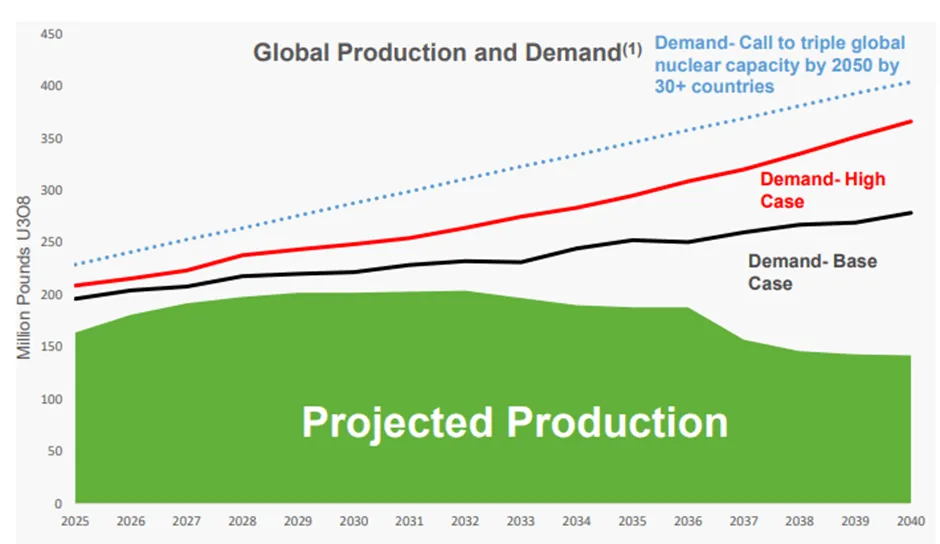
The supply chart tells the other half of the story. Global mine output was roughly 152 million pounds in 2022 against reactor demand of 170 million pounds. That 18 million pound gap was bridged by secondary sources - inventory drawdowns, recycled material, secondary market transactions. Those buffers are finite. UxC forecasts 2025 global mine production at 164 million pounds - still below reactor requirements. By 2040, analysts project a shortfall approaching 130 million pounds annually. Consider the scale of the mismatch: the Trump administration's executive order to quadruple US nuclear capacity alone would add roughly 150 million pounds of annual U3O8 demand - nearly doubling total current world mine production. That's before counting China, the UK, or the Czech Republic.
The term contracting market confirms that utilities sense the pressure. Yet they've been slow to act. Through mid-2025, utilities have signed only 27 million pounds in the term market - less than one-third of the replacement rate needed to maintain coverage. This delay reflects policy uncertainty (will the IRA nuclear credits survive?) and price volatility. But with term contracting lead times now fallen to just 2.6 years, utilities should be growing alarmed about future availability. Sprott describes this as "pent-up demand that must eventually return to the market" - and when it does, it will collide with a supply side that is structurally unable to respond quickly.
The critical point for UEC specifically is that a large chunk of this supply problem is geopolitical, not geological. Kazakhstan and Russia control ~40% of global supply. And the fragility of that supply chain is being tested in real time. In June, Niger announced it will fully nationalize the Somair uranium mine - one of the country's largest uranium assets - tightening state control over a critical link in the Western fuel cycle. Meanwhile, Cameco's Inkai joint venture in Kazakhstan was suspended for three weeks in January on a directive from partner Kazatomprom, with revised 2025 production cut to 8.3 million pounds from earlier targets. No deliveries from Inkai are expected until the second half of the year. Even BHP - the world's largest miner by market cap - reported an 18% year-over-year decline in uranium production at Olympic Dam, and confirmed that its planned copper expansion will add only marginal uranium growth of roughly 1%.
The US has made reducing dependence on that supply chain a national security priority. A Section 232 national security investigation into critical minerals, including uranium, is underway - the same investigation framework used to impose 50% duties on steel and aluminum. That's an explicit political tailwind for the only US company with the licensed capacity to actually do something about it.
The policy environment has shifted more in the last six months than in the previous twenty years. And I don't mean that in the generic "government support" sense - these are concrete legislative and executive actions with specific numerical targets that directly change uranium demand math.
The Big Beautiful Bill, passed on July 4, 2025, preserved the IRA production tax credit for nuclear energy while significantly scaling back incentives for wind, solar, hydrogen, and EVs. This clarity is consequential. Many utilities had paused long-term uranium procurement to assess whether IRA repeal efforts would impact credit availability. With the legislative outlook now settled, the path is clear for utilities to resume contracting with improved forward visibility.
The four nuclear-focused executive orders signed in May 2025 go further still. First reforms the Nuclear Regulatory Commission: construction permits and operating licenses must be reviewed within 18 months (previously 30-42 months), NRC cost recovery will be capped (recent reactor designs had incurred $45-70 million in NRC fees alone), and licensing rules will be overhauled entirely. Second directs the reinvigoration of the nuclear industrial base: 5 GW of increased output from existing plants, construction of 10 large reactors by 2030, and a plan to expand US uranium conversion and enrichment capacity. Third deploys advanced nuclear for national security, including a requirement that a military base operate a nuclear reactor by 2028. Fourth creates a pilot program for three new test reactors.
The math on the NRC reform order alone is staggering. Quadrupling US reactor capacity would push annual uranium requirements from roughly 50 million pounds of U3O8 equivalent to nearly 200 million pounds. For context, total global mine production is forecasted at 164 million pounds for 2025. A single country's policy ambition would require more uranium than the entire world currently produces. Even if only half of this materializes, the supply deficit widens from "structural" to "structural and politically mandated."
The AI and data center demand layer compounds this. According to BloombergNEF, US data centers are projected to consume 8.6% of total electricity demand by 2035, up from 3.5% today. In response, there have been 16 US nuclear power announcements tied specifically to data centers and AI, totaling over 28 GW of capacity - nearly 30% of the US's current nuclear fleet. Amazon expanded its partnership with Talen Energy in June: Talen will supply up to 1,920 MW of clean power from its Susquehanna nuclear plant to AWS as part of a $20 billion investment. That Switch-Oklo partnership targets 12 GW of nuclear capacity phased through 2044. Microsoft, Google, Meta, and Oracle have collectively announced deals for 10.7 GW. These are not aspirational press releases - they are binding capacity agreements from companies with the capital to execute.
UEC is already positioning for this. In May 2025, UEC signed a memorandum of understanding with Radiant Industries to supply domestically sourced uranium for Radiant's Kaleidos portable nuclear microreactor, planned for mass production and testing at Idaho National Laboratory. This is the domestic supply chain the executive orders are designed to build - and UEC is the anchor supplier.