There is a particular kind of setup that I have learned to pay attention to over the years - the kind where the numbers look terrible, the headlines are hostile, and the analyst community is split right down the middle. That is where Tesla sits as I write this in early May 2024.
Q1 was objectively bad. Revenue declined 8.7% year-over-year - the first drop since the pandemic. Deliveries fell 8.5%. Free cash flow went negative for the steepest quarter in company history. The stock had shed 41% from its late-2023 highs before a sharp bounce on China FSD headlines and the August 8th Robotaxi unveil announcement. The bears are writing obituaries for the EV growth story.
And yet. When I read seven independent analyst frameworks back-to-back, listened to the full Q1 earnings call, and mapped the catalyst calendar for the next twelve months, what I found was not a company in decline. What I found was a structural inflection point hiding behind a cyclical trough. The question is not whether Tesla is having a bad quarter. It obviously is. The question is whether this bad quarter is the final chapter of a deteriorating narrative - or the darkest hour before a multi-catalyst recovery that the market has not yet priced.
I believe it is the latter. Here is why.
Ian Andy, Market Research Desk, Bellwether Research, May 9, 2024
Business is non-linear. No company on earth grows revenue at a steady 15% or 25% in perpetuity - especially not one generating nearly $100 billion in annual sales. Tesla is undoubtedly going through a period of non-linearity right now, as most clearly communicated by its 8.5% decline in overall revenue, which followed a year of steadily decelerating growth. EV sales dropped from $18 billion to $16 billion in Q1 - a 13% decline in automotive dollar sales - and for the first time outside the pandemic, Tesla delivered fewer vehicles year-over-year in an absolute sense. In the U.S. alone, Tesla sold 21,443 fewer vehicles than Q1 2023. Free cash flow swung to negative $2.5 billion - the steepest negative quarter in company history and the first time cash flow turned red since Q2 2021.
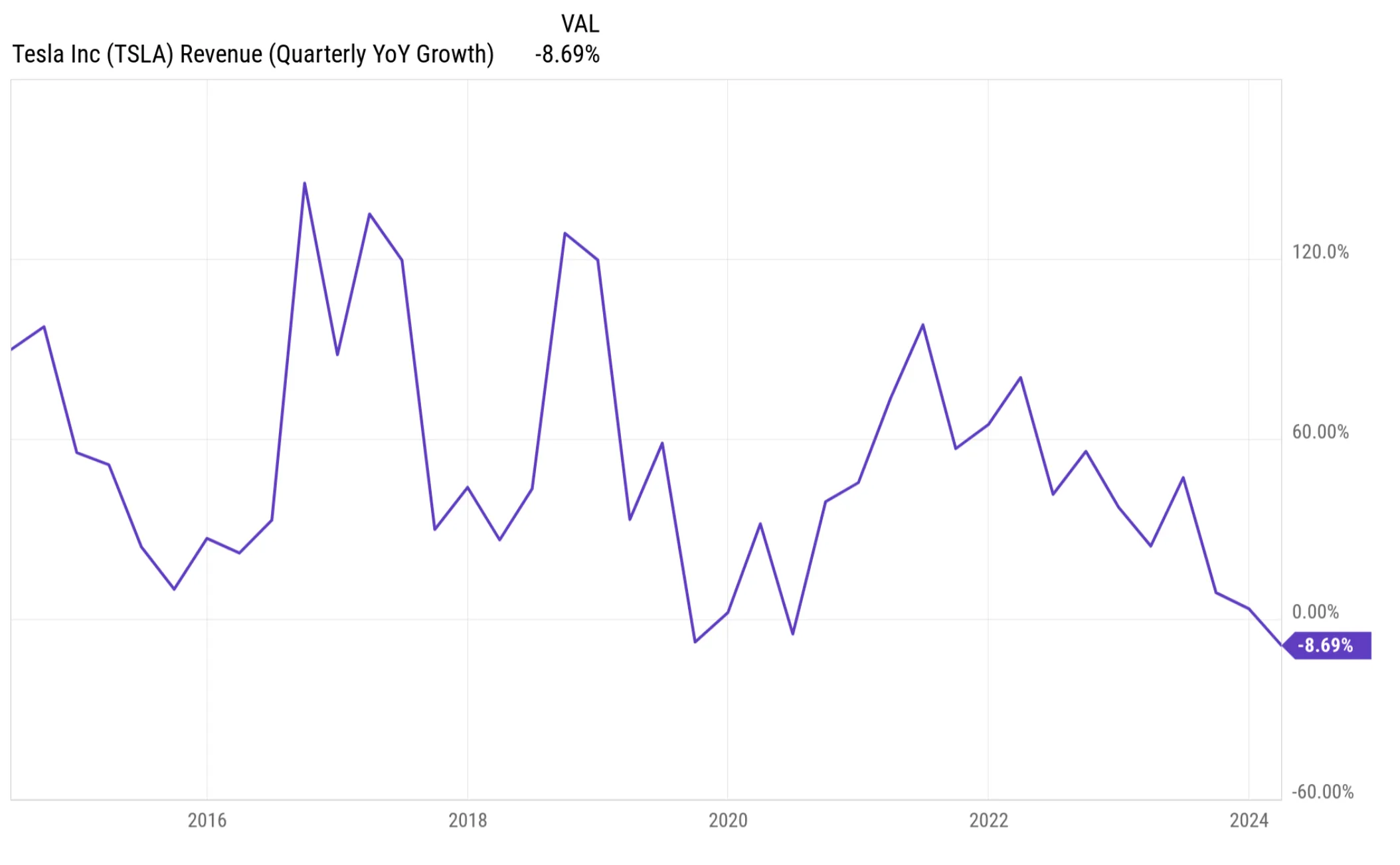
In late 2020 and 2021, the common refrain from Tesla bulls was that 50% annualized revenue growth should be expected. The law of large numbers always made that unlikely once Tesla reached the scale it had achieved. Layer on the fastest rate-hiking cycle in 40 years - which made vehicle financing dramatically more expensive - and you have the context for this deceleration. This is not a Tesla-specific problem. It is an industry-wide compression. Nearly 80% of new car purchases in the U.S. are financed with debt, and JPMorgan’s Jamie Dimon has warned that rates could climb even higher. When the cost of a 60-month auto loan rises by 200+ basis points, it does not matter whether you are selling a Model Y or a RAV4 - demand gets pulled forward, then collapses.
Ford’s EV sales growth has collapsed. BYD’s sales declined year-over-year. Even Toyota and Volkswagen are seeing deceleration. But here is the number that reveals this is cyclical, not structural: while Tesla lost those 21,443 units in the U.S., BMW, Hyundai, Ford, Rivian, and Mercedes-Benz added a combined 35,656 EV units in the same period. The pie is not shrinking - it is being redistributed during a temporary demand compression. The underlying trend - EVs moving from 12% of global car sales toward eventual dominance - has not changed. The pace has temporarily slowed because money became expensive.
What separates Tesla from its competitors in this downturn is how it is responding. While other automakers retreat - pulling back EV investment, cancelling models, reverting to plug-in hybrids - Tesla is investing through the cycle. The company announced a 10% headcount reduction (roughly 14,000 jobs) that will generate well over $1 billion in annualized savings, even as it accelerates spending on AI training compute, FSD development, and Megapack capacity. It sits on $27 billion in cash with virtually no debt. That is not the balance sheet of a company in distress. That is a war chest for a company playing offense while the rest of the industry plays defense.
“The EV adoption rate globally is under pressure and a lot of other auto manufacturers are pulling back on EVs and pursuing plug-in hybrids instead. We believe this is not the right strategy and electric vehicles will ultimately dominate the market.”
- Elon Musk, CEO, Q1 2024 Tesla Earnings Call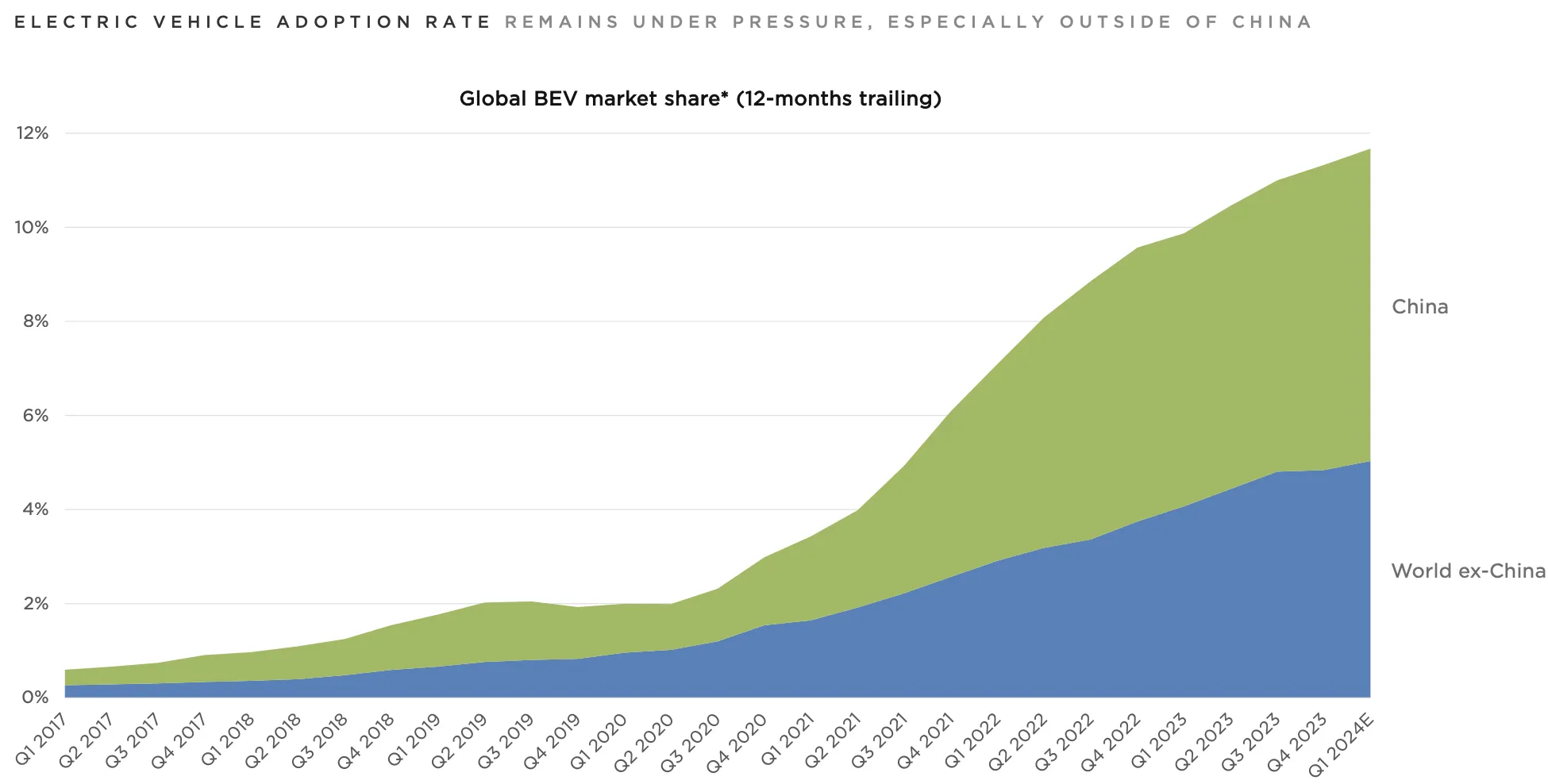
What matters to my thesis is that the non-linearity cuts both ways. If the decline was driven primarily by rates - and the evidence strongly suggests it was - then the re-acceleration, when it comes, could be equally non-linear. Companies that invest through cyclical troughs while competitors retreat tend to emerge with wider moats and faster growth on the other side. That is exactly what Tesla is doing right now.
If there is one chart that captures the core of the Tesla bull thesis, it is this one. FSD cumulative miles driven have gone parabolic - surpassing 1 billion miles - and AI training compute has scaled from near-zero to 35,000 Nvidia H100 GPU equivalents, with plans to reach 85,000 by year-end.
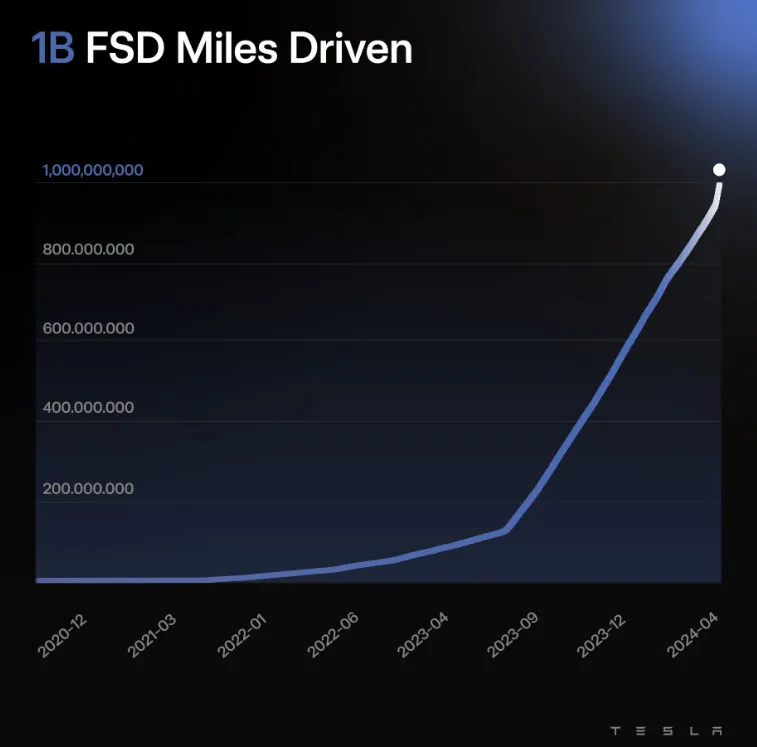
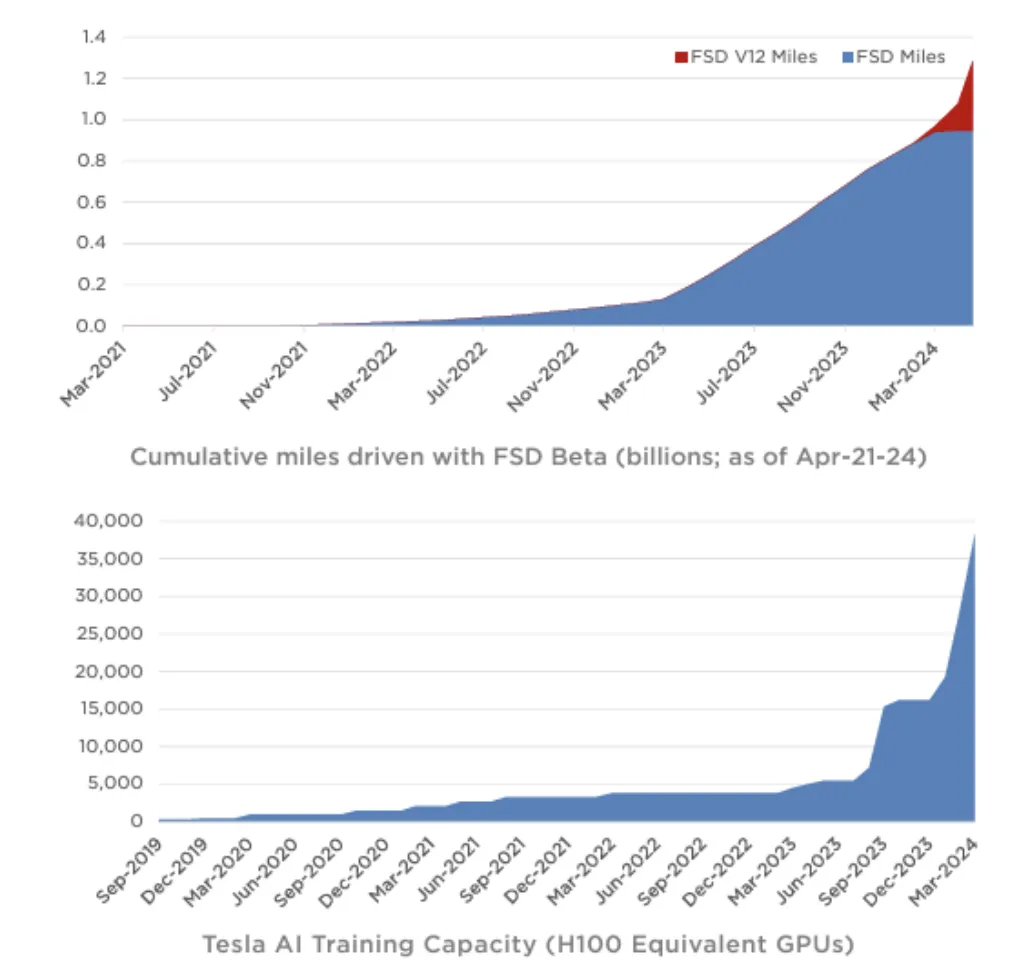
FSD V12 represents a paradigm shift in approach. Tesla eliminated 300,000 lines of hand-coded safety rules and moved to an end-to-end neural network architecture - a system that learns entirely from real-world driving data rather than following pre-programmed instructions. As Ashok Elluswamy, Tesla’s Director of Autopilot Software, explained on the Q1 earnings call: the new architecture “is automatically improving without requiring much engineering interventions - it’s mostly learning on its own based on data.” The more miles driven, the more training data feeds the flywheel. This is the same kind of compounding network effect that makes Google Search nearly impossible to compete with: every query makes it smarter.
The deployment numbers underscore the scale advantage. FSD V12 has been pushed out to approximately 1.8 million vehicles, with roughly half actively using it - a percentage that increases every week. Tesla has reduced the FSD subscription price to $99 per month to drive adoption, prioritizing data collection over near-term monetization. Meanwhile, AI training compute has more than doubled sequentially in Q1, and the team has identified scaling laws - model size, data volume, compute, and architecture - that allow them to predict future performance. This is not speculative. It is systematic.
“As our fleet grows - 7 million, 9 million, eventually tens of millions of cars worldwide - with a constant feedback loop, every time something goes wrong, that gets added to the training data. You get this training flywheel in the same way that Google Search has a flywheel. It’s very difficult to compete with Google because people are constantly doing searches and clicking, and Google is getting that feedback loop.”
- Elon Musk, CEO, Q1 2024 Tesla Earnings CallThe bears rightfully point out that FSD remains at Level 2 on the driver assistance scale - requiring constant human supervision. V12 has had documented near-misses on video. The shift to a pure neural network, while elegant, means those 300,000 lines of safety code are gone - replaced by learned behavior that regulators may view with justified scepticism. There was a 2-million-vehicle recall for Autopilot safety concerns. These are legitimate issues. But they miss the structural picture: no other automaker on earth has over 1 million vehicles on the road collecting real-time driving data for AI training. Waymo operates a few thousand vehicles in geofenced cities with a vastly different hardware approach - a sensor array bristling with LiDAR, radar, HD mapping systems, and layers of redundant safety code. It is a brilliant system, but it is inherently difficult to scale. Waymo was valued at $30 billion in its Series E round. Tesla trades at roughly $500 billion. The market is telling you something about the difference between a geofenced taxi service and a platform that could enable autonomy for tens of millions of vehicles worldwide.
Musk made this explicit on the earnings call: “If somebody doesn’t believe Tesla is going to solve autonomy, I think they should not be an investor in the company.” He went further with an analogy that I found compelling: “In my view, this will be much like elevators. Elevators used to be operated by a guy with a relay switch. We just get in an elevator and press a button - we don’t think about it.” The implication is that autonomous driving will become so routine, so invisible, that the idea of manually controlling a two-ton vehicle at highway speed will seem as archaic as hiring a person to operate a lift. And here is the platform play that most investors miss: Tesla is already in licensing conversations with at least one major automaker for FSD technology. As Musk put it, borrowing from the Nokia playbook: “All cars will need to be smart cars, or you will not sell. License it or nobody will buy your car.” If FSD becomes the Android of autonomous driving - licensed across manufacturers - the revenue model transcends Tesla’s own vehicle sales entirely.
The unit economics of FSD success are staggering. At just 50 million subscribers at $1,200/year by 2035 - a fraction of the global vehicle fleet - FSD alone would generate $60 billion in high-margin recurring revenue. At 35% free cash flow margins and a 25x multiple, that is a standalone $735 billion business. And that is before licensing. FSD is not a nice-to-have. It is the thesis.
On April 28th, Elon Musk met with China’s No. 2 official in Beijing. Within days, China’s Association of Automotive Manufacturers confirmed that Tesla’s Model 3 and Model Y had passed local data security requirements. Tesla reached an agreement with Baidu for navigation and mapping data. The path to FSD rollout in the world’s largest EV market - which accounts for nearly 60% of global EV sales - is now open.
This matters enormously for three reasons. First, Tesla has over 2 million cars already operating in China. That is 2 million potential FSD subscribers and 2 million vehicles that can feed training data into Tesla’s neural network. If even a fraction subscribe at $100/month, the revenue impact is measured in billions.
Second, China FSD data would dramatically accelerate AI training. Chinese driving conditions - dense urban environments, aggressive traffic patterns, mixed-use roads - represent a data goldmine that would make FSD measurably better everywhere, not just in China. One of the most underappreciated features of FSD V12’s end-to-end neural network is its portability: because the system learns to drive like a human, it adapts to local conditions without market-specific reengineering. The analogy Musk used on the earnings call was a human driver landing in a foreign country - the rules may differ, but the fundamental skill transfers. The only local adjustments needed are regulatory specifics, such as China’s strict prohibition on crossing solid lane lines (a heavy fine, versus a mere recommendation in the U.S.). Tesla has been preparing for this since 2021, when it established a dedicated local data center in Shanghai to comply with China’s data sovereignty requirements - a move that now positions it ahead of every Western competitor on regulatory readiness.
Third, regulatory approval opens the door to FSD licensing to local manufacturers. With at least 10 major domestic EV makers competing in China - BYD, XPeng, Li Auto, Huawei, Xiaomi, and others, all investing aggressively in autonomous driving - Tesla could become the autonomous driving operating system of the Chinese EV market. That is a platform play, not a hardware play. Canalys forecasts the global EV market will grow 27.1% in 2024, reaching 17.5 million units. China represents nearly 60% of that total. Being the platform standard in a market of that scale changes the revenue model fundamentally.
The stock surged 15% on the China news alone, and the rally continued through subsequent sessions. The market is telling us this catalyst matters. The question is whether the full revenue potential - FSD subscriptions from a growing Chinese customer base, accelerated AI training, licensing optionality, and billions of miles of the most complex driving data on the planet - is properly reflected in the current price. My view is that it is not. Giga Shanghai delivered 947,000 vehicles in 2023 alone, and if even a modest fraction of the 2M+ installed base subscribes to FSD at $100/month, the annualized revenue impact is $2.4 billion - from a single geography, with near-100% gross margins.
The Reuters report that Tesla had scrapped the mass-market Model 2 sent the stock tumbling. Musk promptly responded on X: “Reuters is lying.” The truth, as it often does with Tesla, likely sits in between - and the nuance is actually bullish.
The original Model 2 concept was a $25,000 entry-level EV. In a 2016 world where the average new car cost $34,077, that made strategic sense. But the automotive market has shifted dramatically. In 2024, the average new car in America sells for $48,000 - a 41% cumulative increase, outpacing the 30% general inflation over the same period. A $25,000 EV would destroy margins without delivering meaningfully greater market penetration than a ~$30,000 version. What appears to be happening is a re-scoped Model 2: a stripped-down variant of the Model 3, priced just below $30,000, built on the existing platform using Tesla’s new “unboxed manufacturing” approach - building all major components separately before assembling in one final step, rather than the traditional sequential assembly line. Tesla’s own Investor Day projections suggest next-generation vehicle COGS could decline by 50% versus the current Model 3/Y - implying roughly $20,000 of production cost, with about one-third of the savings coming from unboxed manufacturing alone.
This is smarter for shareholders than a clean-sheet $25K platform. It avoids billions in new platform development costs, preserves margin structure, and still obliterates the competition on price. Consider what a consumer shopping for a ~$30,000 EV actually encounters today: the Polestar 2 starts at $51,000 - only $1,000 less than a Model 3 Performance. The Rivian R2 starts at $45,000 - nearly $7,000 more than a base Model 3. The Hyundai Ioniq 5 commands a significant premium over comparable Tesla models. And every legacy ICE competitor in the mass-market sweet spot - Honda HR-V, Honda Accord, Toyota Camry, Toyota RAV4, Hyundai Elantra, Chevrolet Bolt, VW Taos - suddenly faces an EV alternative from the most recognized brand in electric mobility. As one analyst in our research set put it bluntly: “Most consumers in the market for an EV today simply have no alternative to buying a Tesla.” A $30,000 Model 2 does not just widen Tesla’s addressable market. It practically eliminates the remaining excuses for not switching to electric. I would not be surprised to see two variants - a sedan and a small SUV or crossover - mirroring the Model 3/Y strategy that has proven so effective.
What the bears dismiss as “just another car” is actually category strategy. Tesla has category vision - a trait shared by Apple, Amazon, and Procter & Gamble. Instead of optimizing for quarterly margins, Tesla uses pricing to grow the entire EV category, knowing that as the market leader with 50%+ U.S. share, it disproportionately benefits from category expansion. When P&G launched laundry pods in 2011, the laundry detergent category grew 4x and P&G grew 5x - faster than the market it created. Apple did not compete in the smartphone market; it created it. The tablet market was negligible before the iPad. Tesla is running the same playbook: price aggressively, grow the category, and let your dominant market share compound the returns.
The Amazon parallel is particularly instructive. In the early 2010s, Amazon was pilloried by analysts for its razor-thin margins and apparent indifference to profitability. A widely cited Seeking Alpha article from 2013 questioned whether Amazon could ever justify its valuation. The answer, of course, was that Amazon was not optimizing for quarterly earnings - it was investing to own the e-commerce category, knowing that scale and infrastructure advantages would eventually produce extraordinary returns. Tesla is making the same bet. The price cuts that alarm short-term investors are not desperate inventory clearance - they are the strategic equivalent of Amazon’s free shipping: a category-expanding investment that looks like a cost today and an insurmountable moat tomorrow. The plan, as with Amazon, is to shift focus to margins once the EV category reaches the “late majority” phase of adoption.
The Model 2, in whatever form it takes, is the vehicle that pushes EVs from “early adopters” across the chasm to “early majority.” That transition - from ~12% to 35%+ of new car sales - is where the hockey-stick growth lives. Tesla is positioning to own that transition, and the August 8th event should provide the first concrete details. A $299/month Model 3 lease is already available. A $30,000 Model 2 purchase changes the math entirely for the median American household.