There is a moment in every commodity cycle when the destruction of value becomes so complete, so thorough, and so emotionally exhausting that the last remaining investor either gives up or quietly doubles down. Lithium in August 2024 is at exactly that moment. The metal that was trading at over $80,000 per metric ton in late 2022 - when every EV startup needed priority supply and every OEM signed long-term contracts in a panic - is now scraping $10,000 per metric ton. An 87% collapse in less than two years.
The company sitting at the epicenter of this collapse is Sociedad Química y Minera de Chile S.A. - known simply as SQM - a Chilean mining and chemical group that controls the world's most productive lithium brine operation in the Salar de Atacama. Its stock, which peaked near $110 in mid-2022, trades today around $37. The market has already priced in a great deal of permanent damage.
What the market has not priced in is this: SQM produces lithium at a cash cost of approximately $5,000 per metric ton - less than any other meaningful producer on the planet. At $10,000 spot, the company still makes money. Its Q2 2024 results show a 16.5% net margin, $213 million in net income for a single quarter, and record lithium sales volumes of 52,000 metric tons - even in the worst pricing environment in a decade. Meanwhile, the company just signed a partnership agreement with state miner Codelco that locks in its rights to operate the Salar de Atacama until 2060. The license risk - the single biggest long-term uncertainty overhanging this stock for years - has been resolved.
Lithium prices will not stay at $10,000 per metric ton. The math is simple: most new projects globally are unprofitable at these levels. Higher-cost capacity is being shut down. SQM is taking the opposite approach - holding production steady and gaining market share while peers retreat. When demand from the secular EV transition catches up to today's oversupply, SQM will be positioned better than it has ever been. The entry zone of $XX–$XX is not a trade on tomorrow's lithium price. It is a position on where the world will be in 12 to 18 months.
Ian Andy, Research Desk, Bellwether Research, August 23, 2024
SQM at a Glance
Sociedad Química y Minera de Chile S.A. is one of the world's largest producers of lithium, iodine, potassium nitrate, and specialty plant nutrients. Its flagship operation is the Salar de Atacama in northern Chile - the world's most productive lithium brine deposit, sitting at over 4,500 meters of altitude in the driest desert on earth. Unlike hard-rock lithium mining, which involves crushing spodumene ore and intensive chemical processing, SQM's brine operation uses the desert sun to evaporate naturally occurring lithium-rich saltwater into progressively concentrated pools - a vastly simpler and cheaper process. That geological accident is the source of SQM's structural cost advantage and its dominant position in the global supply chain.
SQM is not a pure-play lithium miner. Its iodine business - where Chile commands over 60% of global supply - has been delivering double-digit revenue growth in 2024, driven by demand from X-ray contrast media and LCD manufacturing. Its potassium nitrate segment for specialty agriculture is quietly resilient. These businesses provide a critical revenue floor when lithium prices are suppressed. In the second quarter of 2024, iodine revenues rose 22% year-over-year. That is not what a company in crisis looks like.
The Anatomy of the Collapse
To understand why SQM is interesting at $37, you need to understand why lithium did what it did - because the story of the 2022–2024 collapse is a textbook commodity cycle, not a structural technology problem.
It began with genuine, extraordinary demand. Electric vehicle sales accelerated sharply through 2021 and 2022, driven by government incentives, falling battery costs, and a surge in post-pandemic consumer spending. Lithium carbonate spot prices - sitting at roughly $7,000 per metric ton in early 2021 - hit over $80,000 per metric ton by November 2022. A tenfold increase in under two years.
At those prices, every lithium project that was economically marginal suddenly looked like a gold mine. Miners everywhere - in Chile, Argentina, Australia, China - rushed capital into capacity expansion. Meanwhile, EV growth rates, which had been extraordinary, began to normalize. Europe's EV sales slipped as government incentives were reduced in Germany and France. US growth slowed to a 7% quarterly rate in early 2024. China continued to grow strongly, but not fast enough to absorb the incoming supply wave.
The result was a spectacular oversupply. Prices that peaked above $80,000 declined to roughly $10,000 by mid-2024 - a 87% collapse. The narrative shifted from "lithium shortage crisis" to "lithium glut." Company revenues cratered. SQM's revenue fell 37% year-over-year in Q2 2024. Albemarle announced plans to shut half its Australian processing capacity. The pendulum had swung all the way to the other extreme.
"The cure for low prices is low prices."
- Classic commodity market principle, observed in oil, copper, coal - and now lithiumThis is the pattern. High prices attract excessive investment. Oversupply drives prices down. Low prices make new investment uneconomical and force existing capacity offline. Demand, still growing on the secular EV trend, eventually catches up to reduced supply. Prices recover. The cycle resets. It happened in oil in 2015–2016. It happened in iron ore. It will happen in lithium - the only question is the timing.
What makes SQM particularly compelling in this moment is precisely what makes commodity cycle investing difficult: you are buying maximum pessimism. The market is pricing SQM as though the oversupply is permanent, EV growth has peaked structurally, and the lithium cycle will not recover. Every one of those assumptions deserves serious scrutiny.
Profit at the Trough - Reading the Numbers
The most revealing thing about SQM right now is not that it is struggling. It is how little it is struggling at these conditions. The Q2 2024 profit flow diagram tells that story precisely.
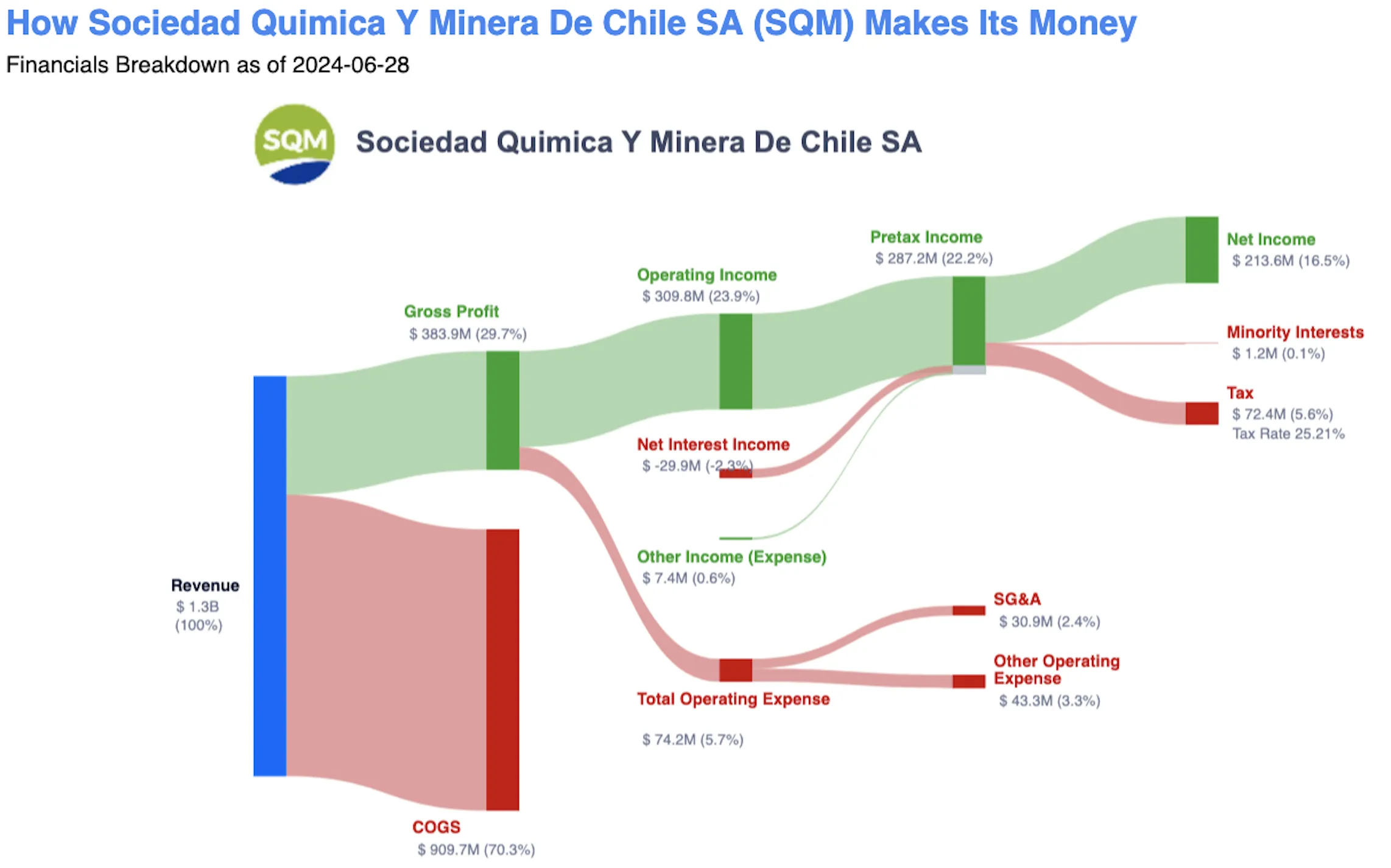
At first glance, the picture appears stressed: COGS consumes 70.3% of revenue ($908.7M), a significantly elevated ratio compared to the boom-era margins SQM enjoyed when lithium was at $50,000+ per metric ton. But read the numbers more carefully and a different story emerges.
Even after that elevated cost ratio - which directly reflects the compressed lithium price environment - SQM generates gross profit of $383.9M, an operating income of $309.8M (23.9% margin), and ultimately net income of $213.6M at a 16.5% net margin. This is not a company bleeding cash. This is a company running profitably at the bottom of its worst pricing cycle in a decade.
The tax line ($72.4M, 25.21% rate) is now normalized following the one-time $1.1 billion accounting adjustment in Q1 2024 related to the Chilean lithium mining tax from prior years. That Q1 distortion - which had no significant cash impact (most of it was already paid in previous years) - caused an alarming headline net loss of $870 million. That overhang is gone. Q2 demonstrates what SQM's ongoing earnings power looks like: approximately $200M+ per quarter in net income at trough lithium pricing.
Now ask yourself: if SQM earns $213M in a single quarter when lithium is at $10,000 per metric ton and COGS is running at 70% of revenue, what do those numbers look like when lithium recovers to $20,000? The Sankey diagram shows you the mechanical leverage: the cost base is largely fixed - brine evaporation is solar-powered and the Atacama doesn't charge rent. Revenue dollars above $10,000 per ton flow through at dramatically higher margins. A doubling of the lithium price could more than triple SQM's earnings per share.
Important Disclaimer
This content is for informational and educational purposes only and does not constitute financial advice, investment recommendations, or solicitation to buy or sell any securities. Past performance does not guarantee future results. All investments carry risk, including the possible loss of principal. Sociedad Química y Minera de Chile S.A. (NYSE: SQM) is subject to commodity price risk (lithium, iodine, potassium), emerging market risk, geopolitical and political risk related to Chilean government policy, currency risk (CLP/USD), regulatory risk including the Codelco JV conditions precedent, environmental and community consultation risk, and general market risk. Lithium prices are highly volatile and dependent on global EV adoption rates, Chinese economic policy, and new supply developments that are difficult to predict. The Codelco partnership terms, particularly the state's 85% operating margin share from 2031, may affect future shareholder returns in ways that differ from historical patterns. The Tianqi shareholder dispute represents an ongoing legal uncertainty. SQM's dividend payments depend on net income conditions as determined by the Board; there is no guarantee of dividend continuity during trough earnings periods. Valuation estimates, price targets, and EPS forecasts are based on publicly available analyst consensus and independent research as of August 2024 and may differ materially from actual outcomes. The technical analysis provided is for context only and should not be the sole basis for any investment decision. Always conduct your own thorough due diligence and consult a qualified financial advisor before making any investment decision.